

Hydrogen Conversion Enhancement for PEMFC through Innovative Design in Materials and Membrane-Electrode-Assembly
Proton Exchange Membrane Fuel Cells (PEMFCs) arguably meet all prerequisites for clean energy transition from fossil fuels, particularly when they use green hydrogen as their fuel, which will significantly reduce anthropogenic carbon emissions. Its implementation to power the road transportation, for instance, is expected to prevent a 3.8 Gt/year projected CO2 emission in 2050 or equal to more than a-fifth of global CO2 emission.
HEROES deliberately focuses on the hydrogen conversion technology of PEMFCs as its main activity, taking into consideration its present challenges and future impacts for medium/heavy-duty applications (e.g.trucks, buses, marine applications).
The working conditions of medium/heavy-duty fuel cells are usually different from those of light-duty fuel cells; for example, long haul, long idle time, and long service time are needed. These conditions require high fuel cell efficiency, e.g., 68–72% in peak efficiency is targeted. Currently, the state-of-the-art PEMFC efficiency for current distributed power systems and transportation is approximately 35-38%, whereas hybrid power generation systems can achieve an efficiency of 60%. To be competitive with conventional power generation systems, the PEMFC for medium/heavy duty applications requires a more improved power conversion efficiency with significant cost reduction.
Medium/heavy-duty PEMFCs are designed to work at high cell voltages to achieve higher energy efficiency, which consequently demands an operation at high voltage. Nonetheless, in this environment, state-of-the-art PEMFC components such as Platinum Group Metals (PGM) electrocatalyst, carbon support, etc., are prone to performance degradation due to electrocatalyst dissolution, carbon support oxidation, and perfluorosulfonate membrane degradation. In this sense, the electrocatalysts with high intrinsic activity are the prerequisites for the medium/heavy-duty fuel cells, while the stability of catalysts at high voltage/high current density is important. The PGM electrocatalyst is also expensive, which makes PEMFC cost high. Consequently, the key challenge in designing competitive PEMFCs is to develop beyond the state-of-the-art, novel low-cost material components (electrocatalyst, Membrane-Electrode-Assembly (MEA), and bipolar plate) that ensure PEMFC performance stability at high voltage operating conditions.
HEROES proposes an integrative approach to boost the PEMFC performance by developing novel oxygen reduction reaction (ORR) electrocatalysts, along with the mechanically robust ultrathin graphitic bipolar plate and innovative MEA fabrications, dedicated to develop a PEMFC with a high-performance-to-cost ratio.
Project goals
The primary objective of HEROES is to develop high-performance-to-cost-ratio PEMFCs capable of high-voltage operation towards 50% HHV cell efficiency with high structural integrity by employing durable and sustainable electrocatalyst, bipolar plate, and innovative MEA designs. The expected results from HEROES are to develop innovative material components that will demonstrate competitive PEMFCs for stationary and heavy-duty applications.
INNOVATIONS
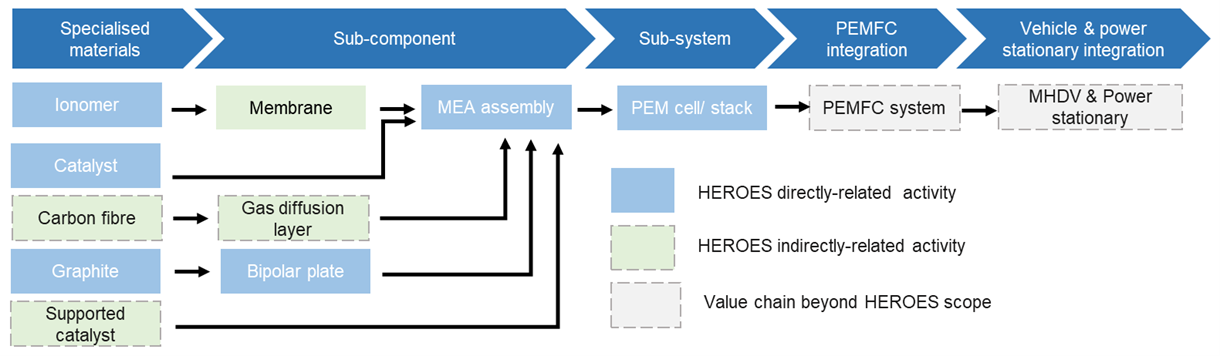
Figure 1. HEROES activities on materials development according to the PEMFC value chain.
The development will be focused on the following novel materials;
- ORR PGM-free electrocatalyst based on M-N-C (M = Fe, Co and Mn) utilizing ZIF-8 metal organic frameworks (MOFs) as N and C precursors (AIT, Austria)
- Novel Poly-ionic liquid (PIL) for improved ORR kinetics (CNRS, France)
- Ultrathin, mechanically robust graphitic bipolar plate (IAG GmbH; Austria).
- Low PGM electrocatalysts preparation (KIER, South Korea)
- Innovative MEA design, materials and integration (Korens RTX, South Korea).
Role of the AIT
The AIT coordinates the project and develops Metal-Nitrogen-Carbon (M-N-C; M = Fe and Co) nanopowders for the new Platinum-Group Metals-free oxygen reduction reaction (ORR) catalysts for PEMFCs application.
Funding

This project is funded by the Federal Ministry for Innovation, Mobility and Infrastructure as part of the M-ERA.NET Call 2023 – Lightweight Construction in Mobility.