


Empowering Co-Creation in Urban Planning with XR and AI-Driven Simulations for Rapid Impact Assessment
Co-Creation for Smarter Cities
Cities are facing complex challenges — from climate change and energy efficiency to social inclusion and mobility. As urban systems evolve, so does the urban planning process, which must integrate diverse expertise, regulatory requirements and stakeholder perspectives. This growing complexity makes early-stage collaboration critical for effective decision-making. Existing processes might benefit from new technologies like AI and XR but often struggle to fully integrate them in their workflows.
EXPLORIA bridges the gap between physical and digital planning environments, creating hybrid co-creation workflows that make decision-making more transparent, data-driven and inclusive.
Through its innovative use of Extended Reality (XR) and Artificial Intelligence (AI), the project aims to transform the static urban planning process into interactive co-creation by turning complex simulations into tangible experiences that empower planners, policymakers and designers to evaluate options collaboratively and assess their impacts immediately. EXPLORIA connects physical and digital environments to support dynamic, practice-oriented decision making and enables stakeholders to explore, shape and refine urban development scenarios in real time.
Project goals
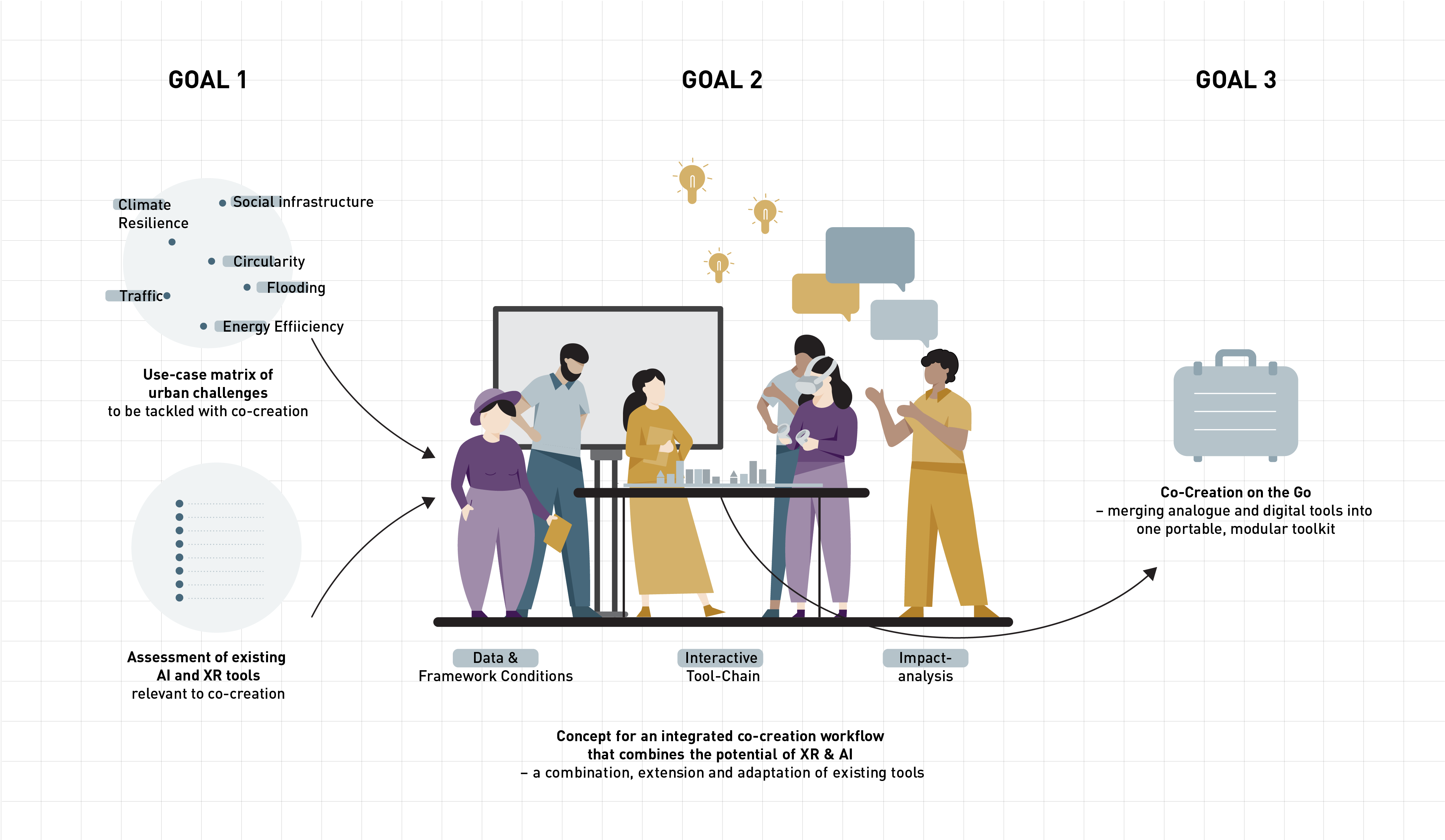
The EXPLORIA project aims to develop an innovative approach to urban planning by blending human expertise with cutting-edge technologies. Unlike existing platforms that are too complicated or too abstract and remain confined to academic or exhibition settings, EXPLORIA focuses on real-world usability and technology acceptance among planning professionals. Its hybrid approach creates a dynamic link between physical interaction and digital simulation, enabling a new generation of planning tools that are both practical and intuitive. By making complex data more accessible and interactive, EXPLORIA supports smarter, more sustainable and more inclusive cities.
Expected Outcomes
- Development of a Use-Case Matrix linking urban challenges to relevant existing XR and AI tools, identifying best practices and adoption barriers.
- Creation of a Workflow Framework that provides an adaptable co-creation process for integrating digital tools into professional planning practice.
- Design of a Mobile Toolkit Proof-of-concept that demonstrates how tangible and virtual tools can merge for collaborative and interactive decision-making.
- Improvement of Guidelines for Technology Acceptance that ensures human-centered design.
Role of AIT
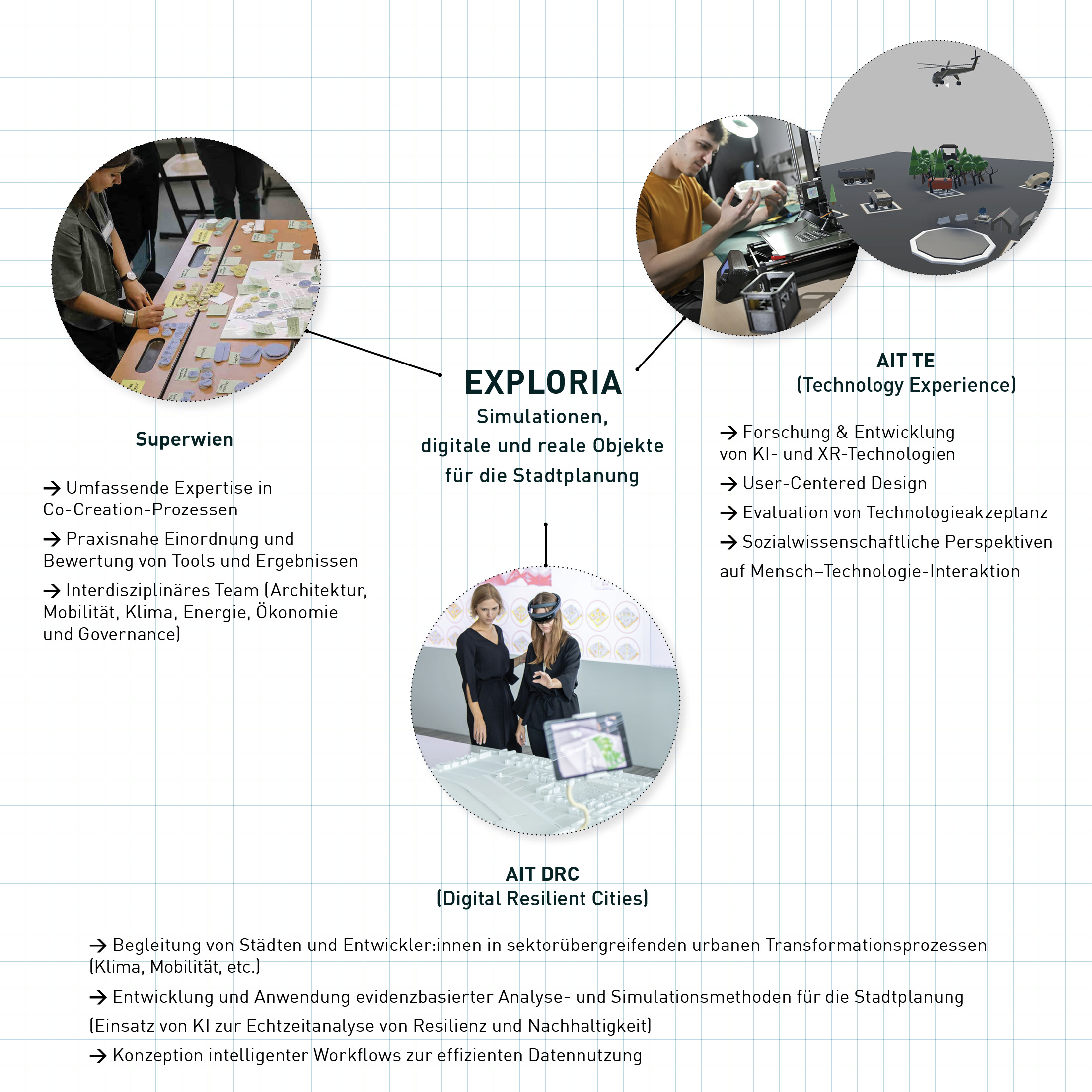
The AIT Austrian Institute of Technology coordinates the EXPLORIA project. The AIT team is actively involved in all work packages and is primarily responsible for tasks in the areas of user research, user experience design, human-computer interaction, XR, AI, digital twins, data analysis, impact assessment and UX evaluation.
Funding
Funded by the FFG – Austrian Research Promotion Agency programme as part of the call for proposals ‘Virtual worlds and digital solutions for health 2024’.