

How close are we to an artificial intelligence that surpasses human capabilities? What opportunities does this development open up for science and business – and what risks does it pose to security and society? To what extent can we benefit from ‘co-intelligence’ today, and what needs to be taken into account when it comes to digital sovereignty? These questions took centre stage at the 2026 CIO Congress in Loipersdorf, organised by LSZ.
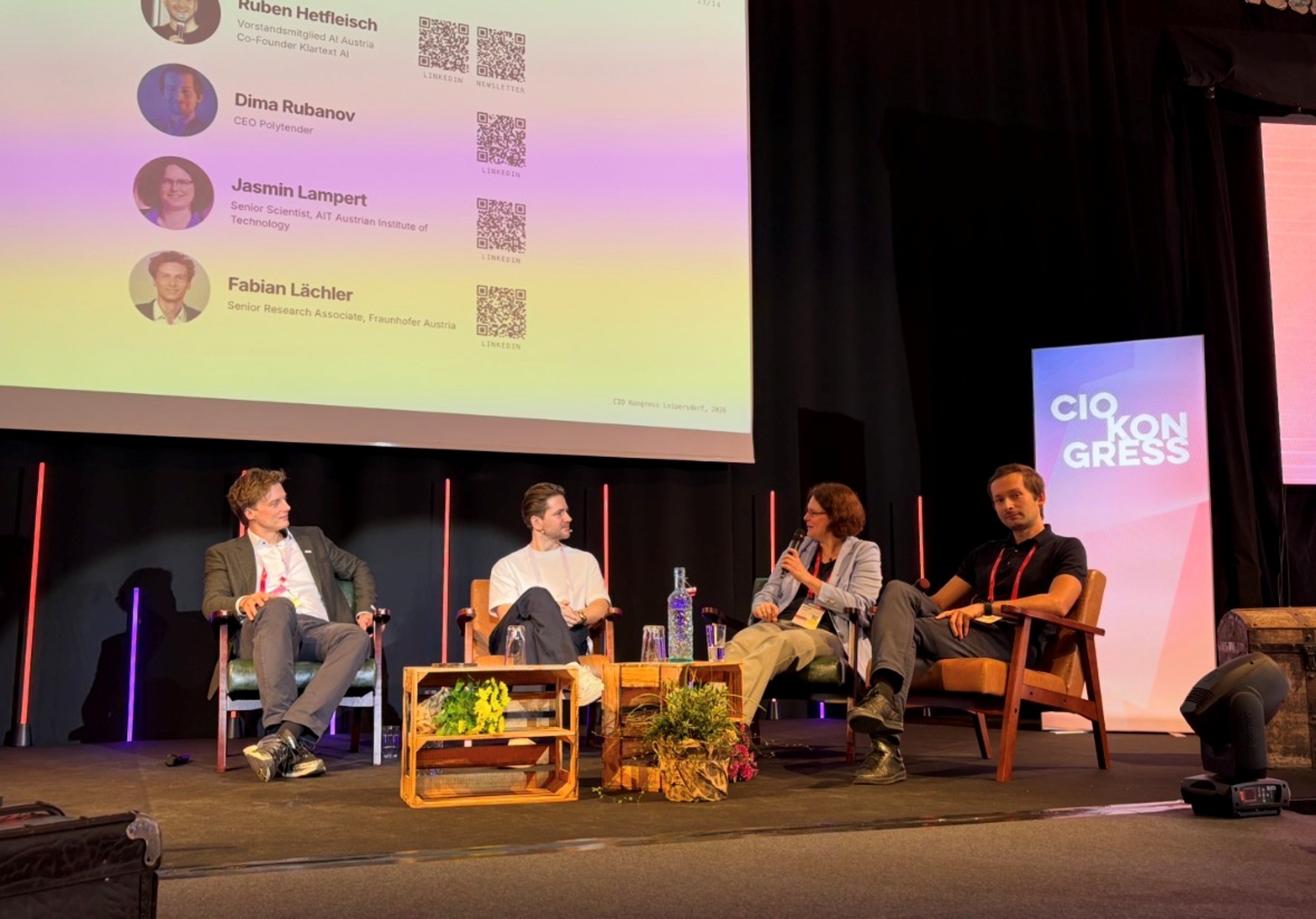
Under the title “AGI & Intelligence Explosion – from ChatGPT to the defining question of the 21st century”, experts from the worlds of research and business examined the rapid advances in artificial intelligence (AI). The focus was on the development of Artificial General Intelligence (AGI), the possibilities offered by autonomous AI systems, and the associated challenges for cybersecurity and European technological sovereignty.
Jasmin Lampert, Senior Data Scientist at the AIT Centre for Digital Safety & Security, joined Fabian Lächler (Fraunhofer Austria), Dima Rubanov (Polytender) and Ruben Hetfleisch (AI Austria) in discussing the technological and societal implications of these developments.
AI as a driver of innovation in science and research
Jasmin Lampert particularly highlighted the potential of AI for scientific research. In fields such as climate and weather modelling or materials science, AI-based methods can significantly speed up complex simulations and enable new scientific insights. At the same time, she emphasised the need to critically scrutinise AI-generated results and to validate scientific findings through interdisciplinary collaboration.
Cybersecurity and the challenges of autonomous AI systems
Another key focus of the discussion was cybersecurity in the age of autonomous AI agents. Networked AI systems open up new opportunities for automation and increased efficiency, but can also significantly exacerbate cyberattacks, disinformation and manipulation.
As a result, security mechanisms, transparent decision-making processes and human oversight of AI systems are becoming increasingly important. Particularly when developing powerful and autonomously operating systems, security and trustworthiness must be taken into account from the very outset.
Europe’s role in AI development
The issue of European technological sovereignty also played a central role. Given the international dynamics in the field of AI, Europe faces the challenge of combining technological innovation with high standards of security, data protection and social responsibility.
Under the title “Resilience & Sovereignty – A (Digital) Breakthrough”, Christian Lacher (Director of IT, Acredia Versicherung), Mathias Nöbauer (CEO of Exoscale, A1 Digital), Jacqueline Wild (VP and Managing Director, ALPS Kyndryl) and Clemens Möslinger (CIO, Federal Chancellery), moderated by Christine Wahlmüller-Schiller, an expert at the AIT Centre for Technology Experience. All the speakers agreed on this point: in addition to an AI and data strategy, every CIO should also consider and plan a strategy and measures relating to digital sovereignty. This is essential, particularly when it comes to critical infrastructure and one’s own important data.
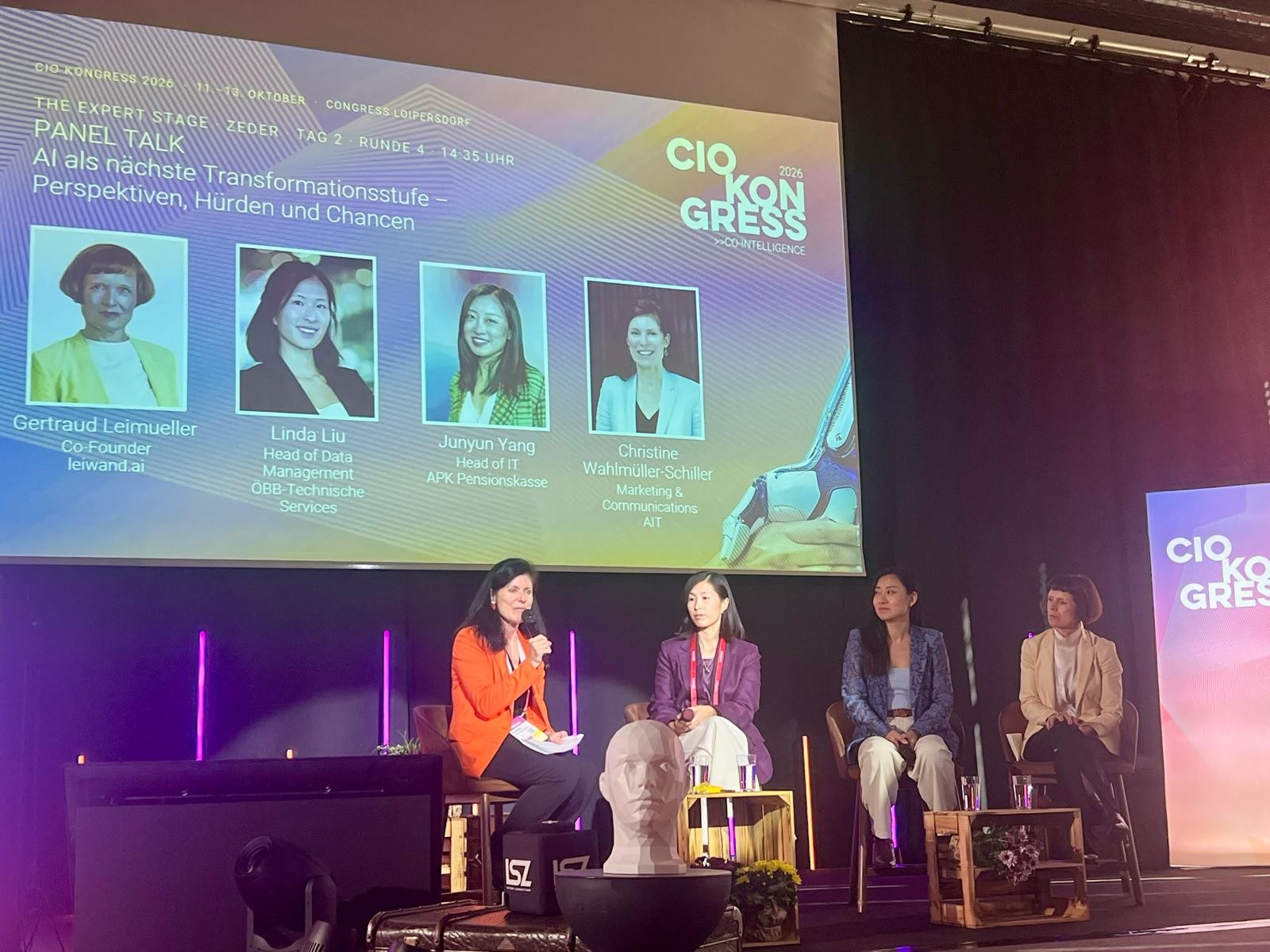
Christine Wahlmüller-Schiller also chaired the all-female panel discussion on the topic “AI as the next stage of transformation – perspectives, hurdles and opportunities” with Linda Liu (Head of Data Management, ÖBB Tech Services), Junyun Yang (Head of IT, APK Pensionskasse) and Gertraud Leimüller (co-founder of leiwand.ai). The conclusion of this discussion was that the use of artificial intelligence is not merely a technological issue; organisational and regulatory aspects must also be taken into account. Equally crucial are the responsible use of AI, the security and reliability of systems and data governance, as well as people’s ability to continue to critically evaluate AI outcomes.
Other AIT participants in attendance included Martin Schiebinger (Head of ITO) as well as Dieter Holzer and Egbert Althammer (both from the Centre for Digital Safety & Security).
LSZ blog post: AGI & Intelligence Explosion – What happens when AI becomes more intelligent than humans?
Photo gallery: Highlights of the CIO Congress 2026