

Decarbonisation strategy, derivation of measures in the fields of action and KPI-based monitoring concept for cities and municipalities
The cities of Traiskirchen, Feldkirch, and Lienz have set the goal of achieving climate neutrality by the year 2030 (Traiskirchen) and by the year 2040 (Feldkirch and Lienz), respectively.
Each city has defined its own specific climate neutrality targets. The cities of Lienz and Traiskirchen aim to reduce greenhouse gas emissions and reach net-zero emissions by 2040 (City of Lienz) and 2030 (City of Traiskirchen), without the use of compensation technologies. In contrast, the city of Feldkirch has set a target to reduce CO₂ emissions to a maximum of one ton of CO₂ per capita by 2040, also without the use of compensation technologies. Feldkirch selected this climate neutrality target because the remaining CO₂ emissions can be offset by preserving and enhancing existing forest, meadow, wet meadow, and moorland areas.
In order to achieve Austria’s climate neutrality goal by 2040, the climate neutrality roadmaps of Traiskirchen, Lienz, and Feldkirch—together accounting for 1% of Austria’s total population—represent an important contribution.
Project objectives: Climate neutrality in municipalities
Development of a climate neutrality roadmap for the cities of Traiskirchen, Feldkirch, and Lienz, including the creation of a current energy and CO2 balance for the base year, the construction of a BAU (Business-as-Usual) scenario and a CNS (Climate Neutrality Scenario), the derivation and prioritization of implementation measures within the fields of action, and the development of a KPI-based monitoring concept.
Role of AIT
In all three projects, AIT's primary role was project management, coordination of project partners, and project implementation.
- Support for the municipalities in collecting data on socio-economic, technological, regulatory, and energy-related aspects
- Assessment, evaluation, and validation of the collected data for further use in AIT’s bottom-up model MAED-City
- Development of a current energy and CO₂ balance for the base year
- Creation of a climate neutrality roadmap using the MAED-City model, based on a participatory process involving local stakeholders, taking into account the following key steps:
- Model calibration through the reconstruction of the base year, representing the most recent typical development characteristics of the city and thus providing a realistic starting point for future projections
- Construction of a BAU (Business-as-Usual) scenario, reflecting recent historical trends without additional measures for the energy transition, serving as a reference point for alternative scenarios
- Construction of a Climate Neutrality Scenario (CNS), representing the targeted energy and climate goals towards a climate-neutral city. The following elements are integrated:
- Key decarbonization drivers: fuel-switch to renewable energy sources, improvements in energy efficiency across all sectors, electrification of end-use, and decarbonization of the local electricity and district heating supply
- Assessment of the local energy potential of the municipality
- Engagement of local stakeholders and decision-makers through workshops and surveys (e.g., citizen surveys and business surveys in the service and industrial sectors)
- Integration of sector-specific targets from the municipalities’ strategic documents
- Derivation of scenario results to project future developments in energy demand and supply, as well as CO₂ balances
- Derivation and prioritization of implementation measures across the sectors of households, services, industry, construction, and agriculture
- Development of a KPI-based monitoring concept, enabling the municipality to track the success of its implementation efforts within the various fields of action.
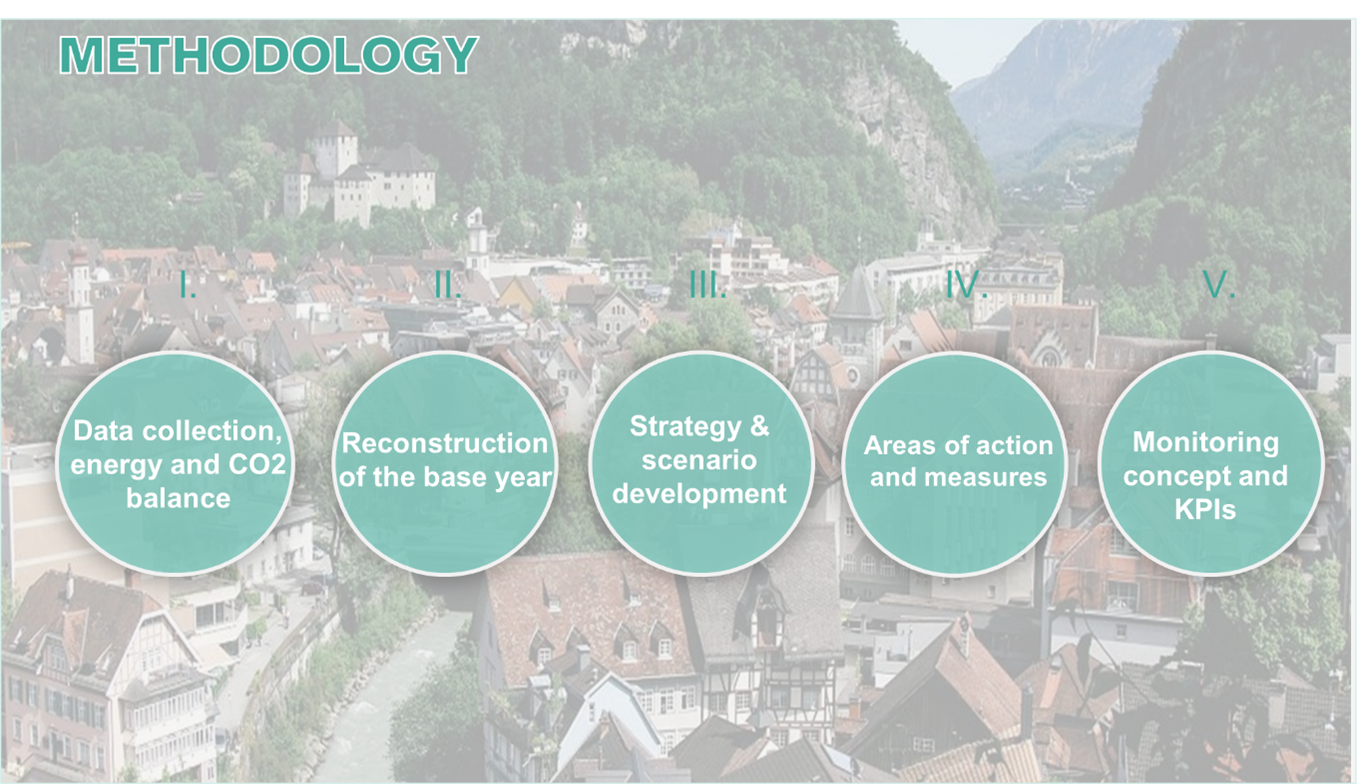
Key steps for developing an urban decarbonisation strategy
Feldkirch climate roadmap
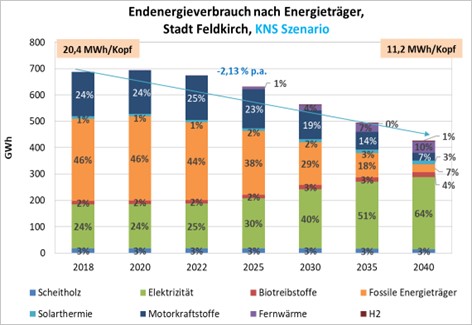
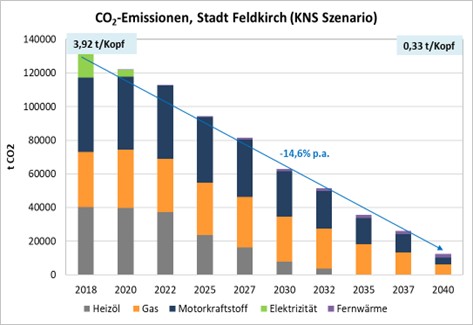
Based on the expected socio-economic and technological developments in the city of Feldkirch by 2040, the Climate Neutrality Scenario (CNS) for Feldkirch yielded the following results:
- Gradual reduction in emissions (decarbonization rate of -14.6% per year) until 2040; from 3.92 tons of CO₂ per capita in the base year 2018 to 0.33 tons of CO₂ per capita in 2040
- Progressive reduction in energy demand from 20.4 MWh per capita (base year 2018) to 11.2 MWh per capita (target year 2040)
- The electrification rate of final energy demand is projected to reach 64% by 2040
- A renewable energy share of 86% in Feldkirch’s final energy demand by 2040, with 34% covered by local renewable energy potentials
Traiskirchen Climate Protection Concept 2030
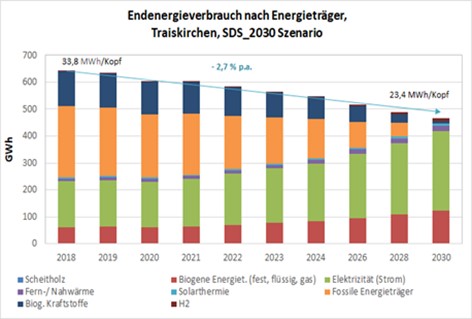
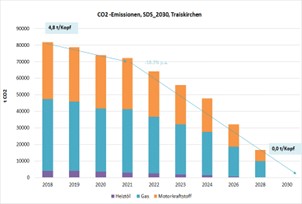
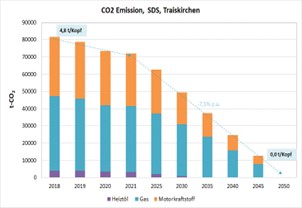
Construction of a Climate Neutrality Scenario for Traiskirchen by 2030 (SDS_2030 Scenario) with the following results:
- Gradual reduction in emissions (decarbonization rate of -15.5% per year) until 2030; from 4.8 tons of CO₂ per capita in the base year 2018 to 0.0 tons of CO₂ per capita in 2030
- Progressive reduction in energy demand from 33.9 MWh per capita (base year 2018) to 23.4 MWh per capita (target year 2030)
- Electrification rate is expected to reach 63% by 2030
- Share of renewable energy sources in Traiskirchen’s final energy demand is projected to be 99% by 2030, with 16% covered by local renewable energy potentials
Traiskirchen Climate Protection Concept 2050
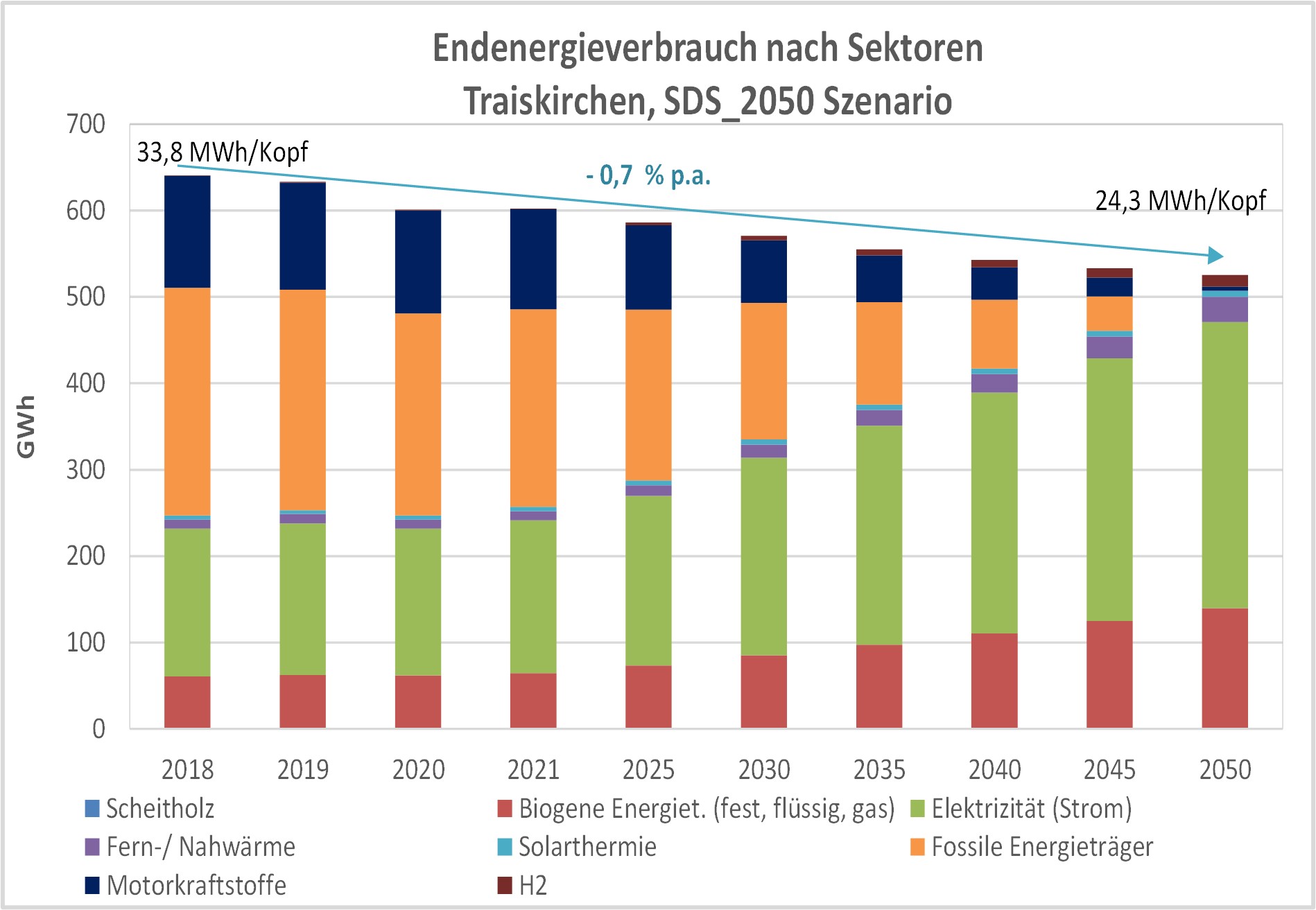
Construction of a Climate Neutrality Scenario for Traiskirchen by 2050 (SDS_2050 Scenario) with the following results:
- Gradual reduction in emissions (decarbonization rate of -7.1% per year) until 2030; from 4.8 tons of CO₂ per capita in the base year 2018 to 0.0 tons of CO₂ per capita in 2030
- Progressive reduction in energy demand from 33.9 MWh per capita (base year 2018) to 23.4 MWh per capita (target year 2050)
- Electrification rate is expected to reach 63% by 2050
- Share of renewable energy sources in Traiskirchen’s final energy demand is projected to reach 100% by 2050, with 14% covered by local renewable energy potentials
Funding
Traiskirchen climate protection concept
The project costs were covered by the municipality of Traiskirchen itself.

Feldkirch climate roadmap
The project was funded as part of the FFG call “Lighthouses for Resilient Cities 2040” and was accompanied by the support process of the BMK and the Climate and Energy Fund.
The support process is organized by the “Urban Management” team, which is based at the Salzburg Institute for Spatial Planning and Housing (SIR) with experts specializing in urban structures.


Lienz climate neutrality roadmap
The project is funded as part of the FFG call “Technologies and Innovations for the Climate-Neutral City 2024” and is accompanied by the support process of the BMK and the Climate and Energy Fund.
The support process is organized by the “Urban Management” team, which is based at the Salzburg Institute for Spatial Planning and Housing (SIR) with experts specialized in urban structures.