


AI-based language support for children in nursery school
WISPER (Vienna Language Experience) is an AI-based language support solution for 3- to 6-year-olds in nursery school, developed by the AIT Center for Technology Experience in close collaboration with the MA10 team (City of Vienna Nursery Schools).
When you watch a child speaking, you see more than just words. You see how they make sense of the world, how they seek connections, how they invent themselves. Research has shown for decades that language is one of the strongest factors determining the educational path a child takes.
In Vienna’s nursery schools, the need for language support is high. Around 26,000 children in nursery schools have a mother tongue other than German (a total of around 88,000 children). There are currently around 400 language support staff in Vienna’s kindergartens. The resources provided by these trained language support staff are limited. Closing this gap is difficult, but failing to do so means that some children start their school life at a disadvantage that is very difficult to make up for later on. It is precisely here, in this structural inequality, that WISPER comes into play.
The starting point for WISPER is precisely this real inequality: early language proficiency is the strongest indicator of academic success, and thus of economic and social participation. Closing this gap was the driving force.
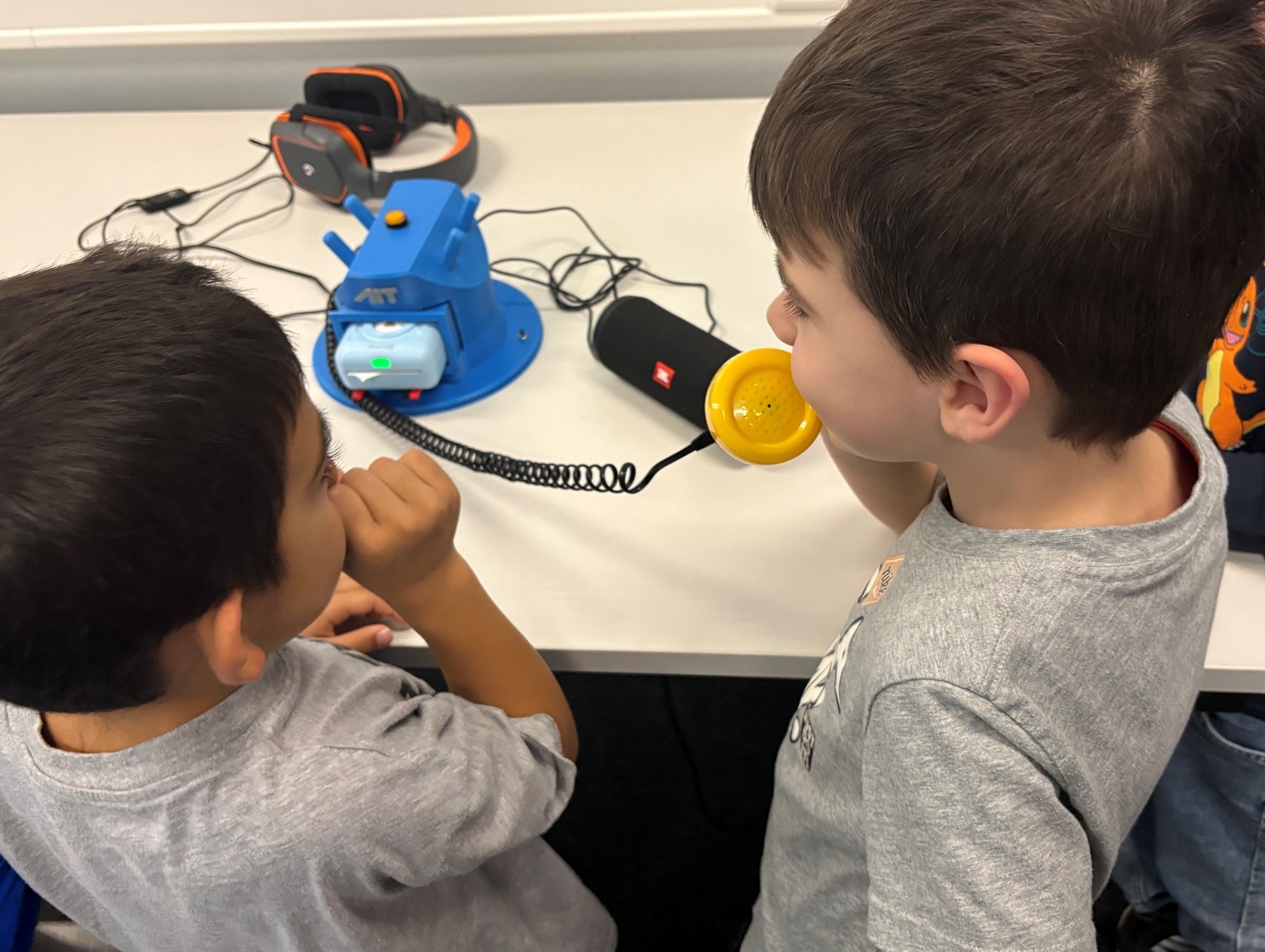
Initially conceived as a ‘talking doll’ or ‘talking train’, the WISPER project revealed that a telephone designed with children in mind is the perfect ‘hardware’. From the very beginning, the focus was on delivering the best possible user experience for the target group of ‘nursery school children’.
How WISPER works in nursery schools
In practice, WISPER works as follows: a child picks up the receiver, starts talking, and a patient, friendly voice listens, responds, asks questions and, step by step, develops a story together with the child. What sounds like a simple idea is, in fact, pedagogically precise in its design. The WISPER system was developed and trained in close collaboration with the City of Vienna’s speech and language therapists – in kindergartens – using the principles of user-centred design and interaction design, based on current scientific standards for language acquisition and with the help of the AI model Gemma 4. WISPER analyses the child’s language level in real time and continuously adapts the conversation and the story. It is not a lesson, but a conversation. The child decides for themselves how long they want to ‘talk on the phone’ and develop the story; afterwards, as a reward, they receive a small picture relating to the story from the printer built into the telephone.
The way it handles multilingualism is particularly effective. WISPER understands every language in the world, but always responds in German. Children who are still in the process of learning the language can briefly switch to their first language in difficult moments without losing the thread of the conversation. No interruptions, no frustration. Instead, fluency, confidence and the feeling of being understood. The result is more than just language proficiency; it is self-efficacy. This forms the foundation for children to step confidently into education and society.
WISPER does not replace a language support specialist or a nursery teacher. It takes some of the pressure off them, thereby giving them more time to focus on those children who need special attention. At the same time, each session provides data on language development trajectories, thus creating an evidence-based foundation for individual support decisions.
WISPER is currently being used in a pilot scheme at the Hinaysgasse nursery school in Vienna and is undergoing methodological evaluation by the AIT Center for Technology Experience. What the children do with WISPER, how they use it, how they interact with it, and where there is still room for improvement – all of this will be directly incorporated into the further development of WISPER. The next step is an extended trial in Viennese nursery schools in 2026.