


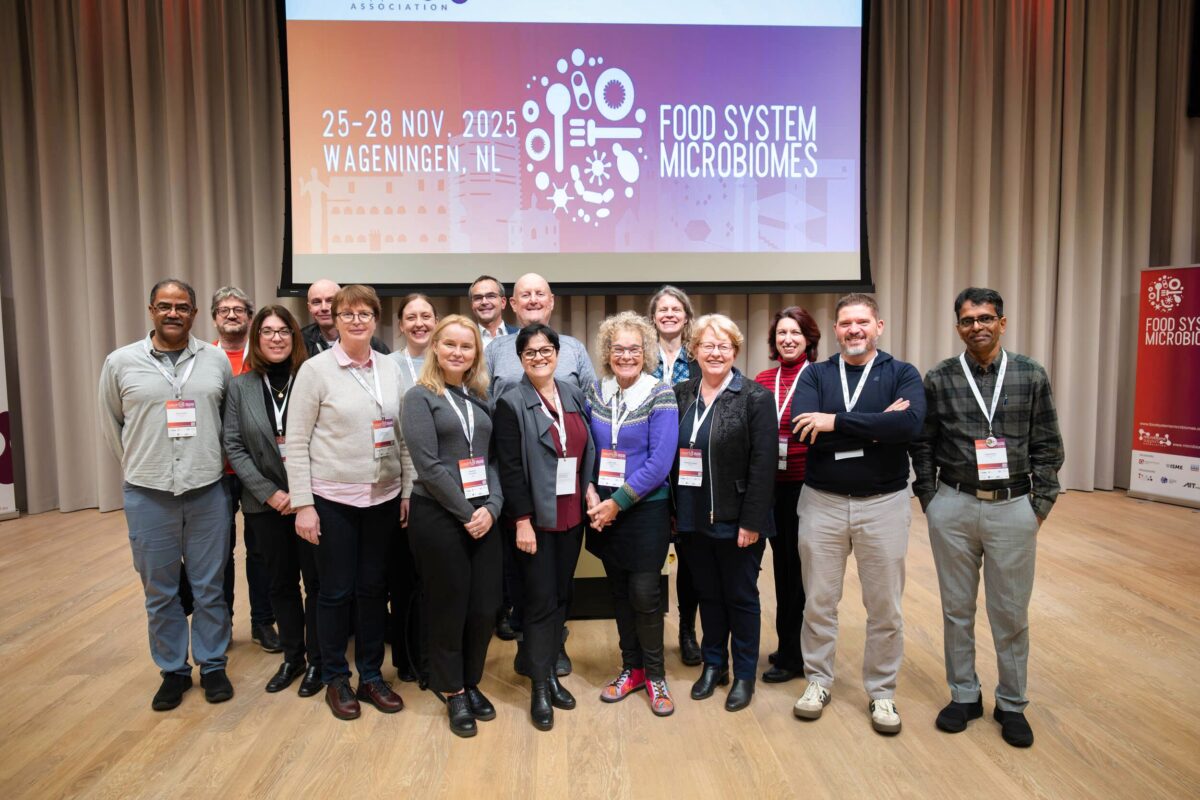
From 25 to 28 November 2025, the Food System Microbiomes Conference in Wageningen brought together more than 180 participants from five continents. The focus was on how microbiomes in soils, plants, animals, foods and humans can be used in a targeted way to make food systems more sustainable, resilient and healthy.
The conference series directly stems from the EU project MicrobiomeSupport, coordinated by Angela Sessitsch at AIT. The project gave rise to the MicrobiomeSupport Association, which organises the conference together with the AIT Austrian Institute of Technology, the Wageningen Microbiome Center and the Austrian Society for Molecular Biosciences and Biotechnology (ÖGMBT). AIT’s Bioresources Unit was strongly involved through scientific contributions and key roles in the project, the association and the organisation.
From MicrobiomeSupport to an international conference
MicrobiomeSupport was set up as an EU Horizon 2020 project with the aim of better connecting the fragmented microbiome research landscape in the field of food systems and developing a shared strategic agenda. Under the coordination of Angela Sessitsch, this resulted in an international network of industry, researchers and decision-makers, a coordinated research and innovation agenda, and formats to bring science, policy, industry and civil society to the table. To secure these structures beyond the end of the project, the MicrobiomeSupport Association was founded. It continues the networking work, anchors the topic in European and international initiatives, and runs the Food System Microbiomes Conference as the community’s central platform. Tanja Kostic plays a key role in the further development of the association and the conference. She has been involved in MicrobiomeSupport from the very beginning and, alongside her work at AIT, is now Managing Director of the MicrobiomeSupport Association. In this role, she combines scientific expertise with the strategic development of the network.
FSM2025 in Wageningen: microbiomes as a connecting element in the food system
The Food System Microbiomes Conference is a forum that brings together microbiome research along the entire value chain. Researchers from soil and plant sciences, animal health, food technology, environmental research and human microbiome research discussed overarching questions: what role do microbiomes play for yield stability and climate adaptation? How can microbial networks in soils and plants be used to reduce fertilisers and plant protection products? How do microbiomes influence processing, shelf life and the quality of foods? And how do these processes affect human health?
The programme combined two keynotes at the interfaces between human health, the environment and food systems with a dense scientific framework: Nicola Segata (University of Trento, IT) spoke on “Human and food microbiomes within a OneHealth perspective”, and Michael Wagner (University of Vienna, AT) on “The many faces of nitrification: From fundamental understanding to paths toward sustainable nitrogen management”. Wagner also coordinates the FWF Cluster of Excellence “Microbiomes Drive Planetary Health”, in which the AIT Center for Health & Bioresources is involved and which pools Austrian microbiome research in the spirit of One Health and Planetary Health. The keynotes were complemented by invited talks, short presentations, poster sessions and a dedicated format for early-stage researchers. A regulatory workshop shed light on how microbiome-based products and applications can be transferred into practice safely and efficiently; an interactive exhibition of European projects, as well as an artistic contribution that translated environmental and microbiome topics into visual stories, opened up additional perspectives. Time and again, the same fundamental question was at the centre: how can the growing knowledge on microbiomes be structured and integrated in such a way that it actually reaches strategy, regulation and practice in food systems?
AIT contributions: soybean value chains and plant-based foods
AIT was scientifically and organisationally present in Wageningen with the Centers Health & Bioresources and Innovation Systems & Policy. One focus was the EU project MICROBIOMES4SOY, which investigates how microbiomes in the soybean value chain can be influenced in a targeted way, from cropping systems and soil and root microbiomes through to processing. The aim is to develop approaches that stabilise yields, use resources more efficiently and reduce environmental impacts. The poster programme included, among other things, transition pathways for the use of microbiome-based applications in the soybean value chain – i.e. concrete steps showing how promising research results can make their way into agricultural practice and industrial use.
Another focus was the ESR session organised by early-stage researchers, in which only contributions from early-career scientists were presented. Among others, Sara Pipponzi (AIT) was selected to present her work on the biofortification of plants with vitamin B12-producing microorganisms. The session focused on how microbiome-based solutions can contribute concretely to the Sustainable Development Goals (SDGs) – for example with regard to food security, sustainable production and healthy ecosystems. “Microbiomes connect soils, plants, foods and our bodies in a single system. If we understand these interrelationships and use them in a targeted way, we can stabilise yields, reduce environmental impacts and produce healthier foods at the same time. Conferences like FSM2025 show how strongly this field is now networked – and how much potential remains.” says Tanja Kostic, interim Head of AIT’s Competence Unit Bioresources and Managing Director of the MicrobiomeSupport Association. Microbiomes are not a niche topic, but the connecting element between agricultural policy, the food industry, the environment and the health system – and thus central to the One Health approach.
From Wageningen to Paris
FSM2025 made clear that microbiome research is evolving from isolated individual applications towards systemic approaches. The debates in Wageningen repeatedly revolved around integration: data and applications from soils, plants, animals, foods and human medicine are to be considered more jointly and assessed along the entire food system.
This results in clear tasks for AIT and the MicrobiomeSupport Association: the further development of integrated microbiome strategies, bridging regulation and practice, and a deeper dialogue with policy and the public on the opportunities, limits and questions of responsibility around microbiome-based innovations.
The conference series will continue in 2027 in Paris. Until then, many of the approaches discussed in Wageningen are to be taken forward in projects, pilot applications and collaborations. The AIT Center for Health & Bioresources and the MicrobiomeSupport Association will continue to help shape this process – as scientific drivers and as a platform for a community that is increasingly also thinking about food systems from the perspective of their microbiomes.
More: https://foodsystemsmicrobiomes.org/ | https://www.microbiomesupport.eu/
