


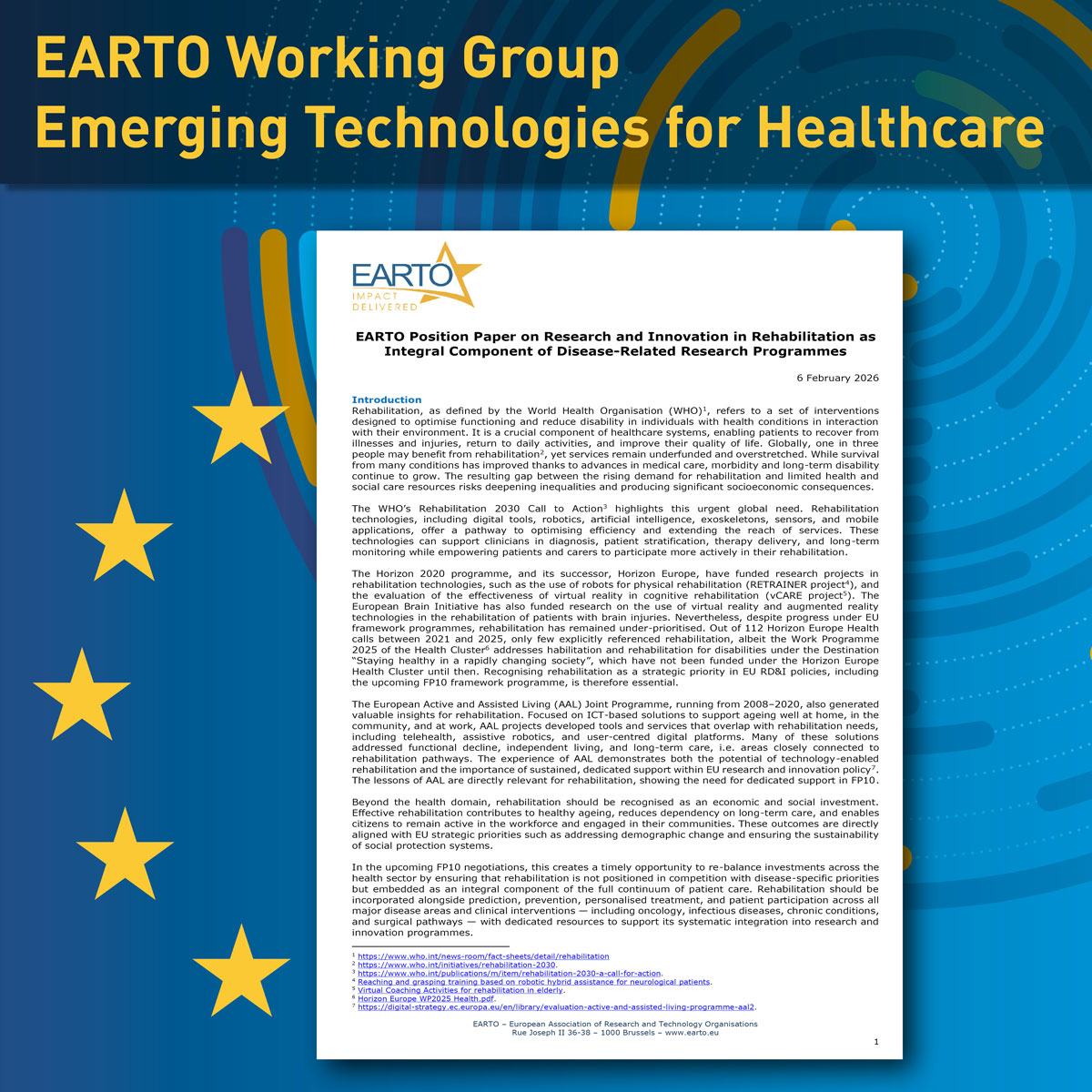
After illness or injury, rehabilitation often determines whether people remain permanently impaired or regain independence. According to the WHO, around one third of the world’s population could benefit from rehabilitation services, yet rehab services in many countries are underfunded and under significant strain. A recent position paper by the EARTO Working Group Healthcare therefore recommends giving rehabilitation greater priority in European research and innovation policy, particularly in the next EU Framework Programme, FP10.
High demand, but low visibility in EU research programmes
EARTO argues that rehabilitation appears only sporadically in EU programmes and, overall, is considered to a limited extent. One indicator: of more than 100 Horizon Europe health calls between 2021 and 2025, only a few explicitly addressed rehabilitation. At the same time, demand is growing, among other factors due to demographic trends, chronic diseases and improved survival rates following severe diagnoses.
The accompanying EARTO report also identifies key barriers that hinder innovation and implementation: fragmented innovation ecosystems, low interoperability and system integration, a lack of robust evidence (including cost-benefit data), uncertainty around reimbursement and procurement, as well as regulatory complexity, for example in the context of MDR and data protection and cybersecurity requirements, which are often difficult to manage in practice.
Rehabilitation as a standard component along the care pathway
The core of EARTO’s position is not “more individual projects”, but a structural principle: rehabilitation should be planned into disease-related programmes from the outset, as part of the care pathway, not as a downstream add-on. It should be systematically integrated alongside diagnostics, therapy, prevention and personalised approaches.
This applies both to clinical research and to the development and implementation of rehabilitation technologies, which must be integrable into care workflows, evidence-based and scalable. “EU-funded research on major disease areas should incorporate rehabilitation from the very beginning, as a standard component along the care pathway. What matters is that solutions are evidence-based, fit into existing processes and can be implemented at scale,” explains Dirk Holste, Chair of the EARTO WG Healthcare and Deputy Head of Center, AIT Center for Health and Bioresources.
FP10 as leverage for evidence, implementation and reliable procurement
EARTO sees the upcoming FP10 process as a concrete opportunity to anchor rehabilitation strategically in a way that ensures research does not stop at prototypes. Proposed measures include large-scale, multi-year and multicentre studies, stronger multi-site validation, practical integration and training concepts, and evidence-based guidelines for procurement and the roll-out of rehabilitation technologies.
The position paper sets out six concrete recommendations, ranging from strengthening the innovation ecosystem and proportional regulation through to evidence-based procurement guidelines. The aim is to translate innovations into care on an evidence-based basis.
Further information and contact options:
EARTO – European Association of Research and Technology Organisations
https://www.earto.eu/our-publications/