


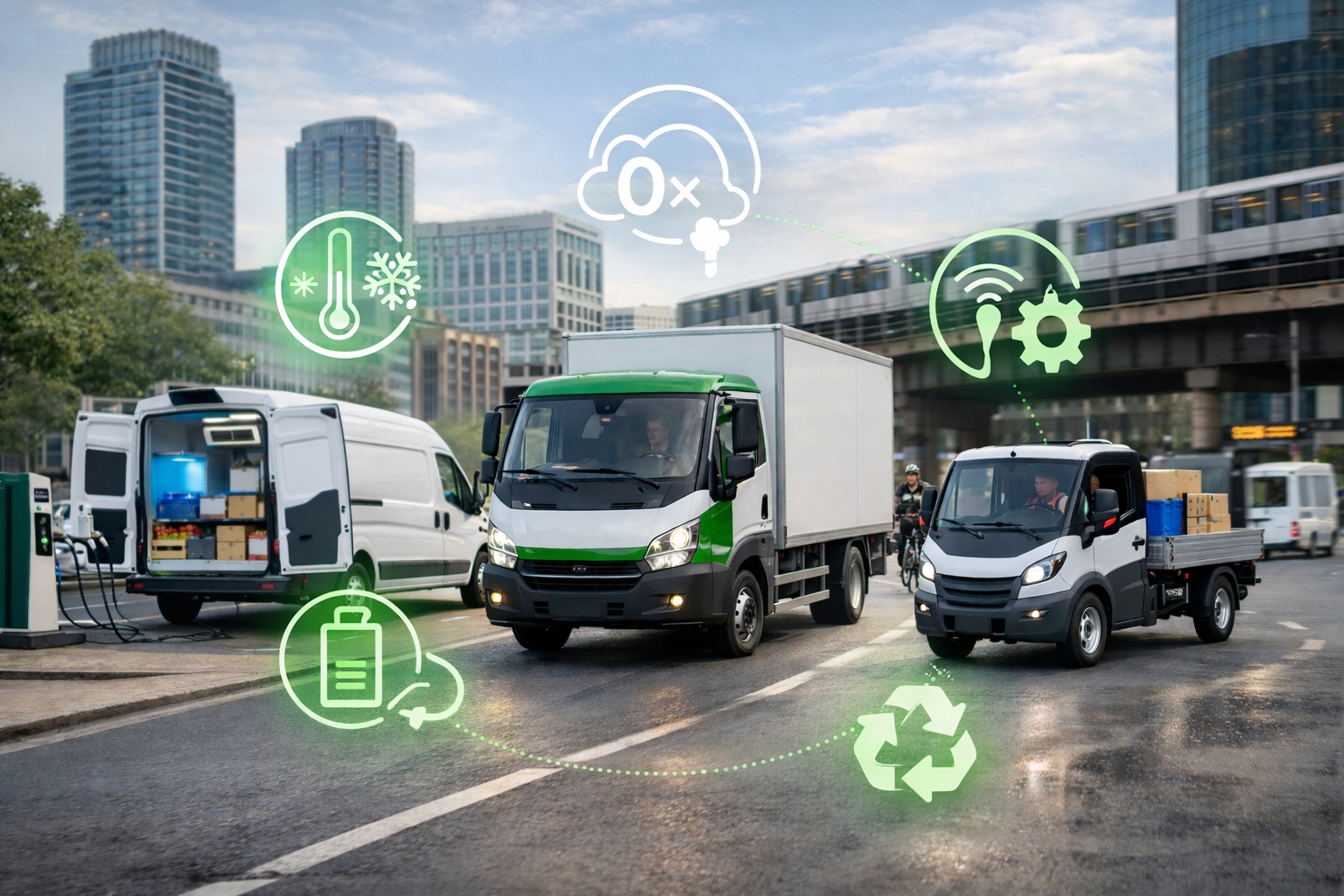
There is growing pressure in Europe's cities to make deliveries faster, more efficient and more climate-friendly. The EU-funded Shift2Zero project is developing tailor-made, application-specific N1 electric commercial vehicles (e-LCVs) that meet the complex requirements of urban supply chains. The AIT Austrian Institute of Technology is playing a key role in integrating innovative technologies such as infrared cabin heating, intelligent thermal management and energy-optimised control strategies into the vehicles. Six prototypes based on the IVECO eDaily and Alkè ATX platforms are being tested in real-world conditions at six European pilot sites – from the cold chain in Brussels to fast city deliveries in Thessaloniki.
The challenge: cities under pressure
Whether in Brussels, Thessaloniki or Bologna, urban deliveries face the same challenges: diesel commercial vehicles continue to dominate the market, but are often oversized, inefficient and not optimised for the diverse transport tasks in cities. At the same time, demand for fast, flexible and temperature-sensitive deliveries is increasing due to e-commerce, food deliveries and returns logistics. Inefficiencies in fleet sizes, load factors and energy consumption, as well as stricter urban access regulations, clearly show that conventional vehicles are reaching their limits. Europe urgently needs emission-free, cost-efficient and flexible solutions for urban logistics.
Shift2Zero: Tailor-made solutions for every mission
Shift2Zero is developing six innovative vehicle concepts that are specifically tailored to urban logistics tasks. They combine:
- Modular cargo space that can be flexibly adapted to different transport tasks
- Multi-temperature cargo space for the simultaneous transport of fresh goods, frozen products and dry goods
- Ergonomic and safe driver's seats that increase comfort and occupational safety
- Energy efficiency through bidirectional charging, regenerative braking, optimised tyre and brake technologies, and intelligent thermal management
- Digital control strategies and IoT integration to operate vehicles efficiently and manage supply chains intelligently
The vehicles are being tested in Bergen, Oslo, Thessaloniki, Bologna, Brussels and Wroclaw to simulate real delivery conditions and test their adaptability to different urban environments. Market analyses, business scenarios, training courses and political consultations are being conducted in parallel to ensure that the concepts can be quickly put into practice.
AIT: Bridging the gap between research and practice

AIT ensures that the vehicles are not only low-emission, but also economical and practical. “By developing infrared cabin heating systems and intelligent heat management, we are helping to optimise vehicle performance while reducing energy consumption”, explains Mirza Popovac, project manager at AIT.
In addition, AIT is responsible for simulations, prototype construction, pilot preparation and dissemination, ensuring that innovations are seamlessly integrated into the vehicles. Particular attention is paid to cold chain logistics, reverse logistics and multi-mission vehicle concepts that enable both the transport of goods and people. This results in a holistic approach that combines technology, energy efficiency and user needs and ensures that the vehicles are ready for the market.
A strong European consortium
Shift2Zero brings together 30 partners from 10 countries, including research institutes, universities, industrial companies, logistics service providers and local authorities. The core partners are Fundació Eurecat, Vrije Universiteit Brussel, Alkè Electric Vehicles, Gruber Logistics, IVECO SPA and Michelin.
The project is funded under Horizon Europe (CL5-2024-D5-01) with a total budget of €12 million (of which €10 million is contributed by the EU). With its combination of research, industry, logistics and politics, Shift2Zero covers the entire value chain and paves the way for the widespread introduction of zero-emission N1 e-LCVs in Europe.
Further information: shift2zero-project.eu

Shift2Zero is funded by the European Union’s Horizon Europe research and innovation programme under GA no. 101192375.