


How can geodata be made available more easily, efficiently and interoperably in future? This question was the focus of the AGEO panel discussion “OGC API – The next generation of geospatial services?”, which took place as part of AGIT 2026 at the University of Salzburg. Representing the AIT Austrian Institute of Technology, Anita Graser, Senior Scientist at the Centre for Digital Safety & Security, discussed the future of modern geodata standards and digital geoinfrastructures alongside experts from research, industry and public administration.
The discussion centered on the OGC API, which, as a modern evolution of established OGC standards such as WMS, WFS and WMTS, enables the exchange of geospatial data using current web technologies. The discussion highlighted that open, standardised interfaces are a key prerequisite for interoperable data ecosystems and thus lay the foundation for innovative applications in areas such as mobility, urban planning, environmental monitoring, critical infrastructure and crisis management. At the same time, the challenges involved in migrating existing geodata infrastructures, as well as the benefits of consistent standardisation for public administration, research and industry, were examined.
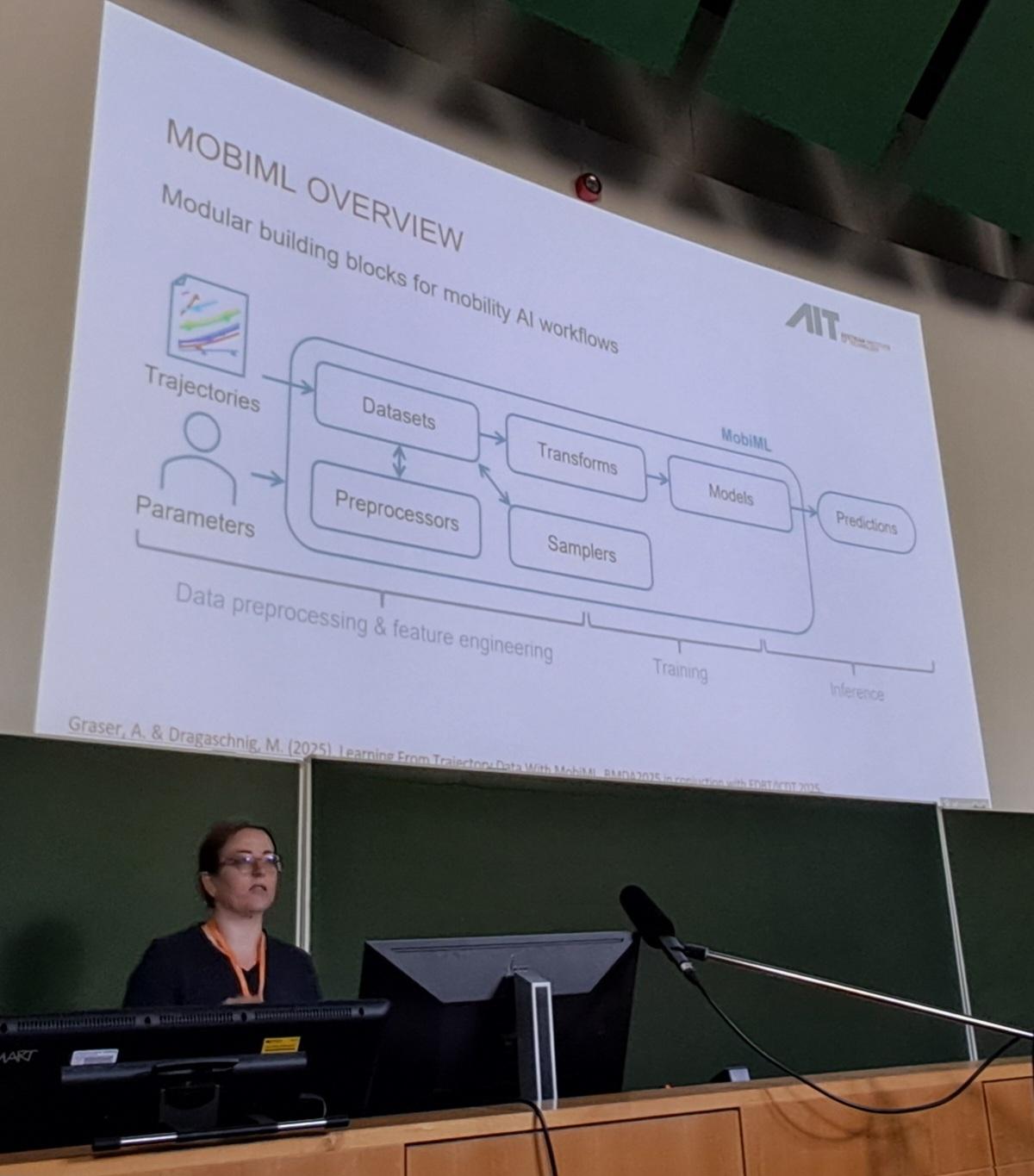
Anita Graser contributed her many years of expertise in the fields of geoinformatics, spatial data analysis, GeoAI and open-source GIS to the discussion. At AIT, she works on data-driven methods for analysing movement and geodata and develops innovative tools for modern geodata analysis. A current research focus is on the application of artificial intelligence and machine learning, as well as the development of powerful analytical tools for large spatio-temporal datasets. In parallel, she presented the paper “MobiML – Accelerating Machine Learning Workflows for Trajectory Data in Mobility Data Science” at AGIT 2026 alongside colleagues, which introduces new approaches to the more efficient use of movement data for AI-supported applications.
The discussion highlighted that open standards such as the OGC API play a key role in digital transformation. They enable the cross-organisational exchange of high-quality geodata and lay the foundation for trustworthy, scalable geodata infrastructures and future-proof data spaces. Particularly in an increasingly data-driven society, they make an important contribution to the development of innovative digital services and evidence-based decision-making processes.
By taking part in the AGEO panel discussion, Anita Graser once again underlined AIT’s leading role in the development of modern geodata and AI technologies, as well as its commitment to open standards and international cooperation in the field of geoinformatics.
Watch the full panel discussion here.