

Comprehensive assessment of technical and realisable renewable energy potentials in Austria
The study “Renewable Energy Potentials in Austria for 2030 and 2040” provides a comprehensive, methodologically consistent, and spatially highly resolved assessment of renewable energy potentials across Austria.
It evaluates all major renewable energy technologies and their possible contributions to the future energy system in the target years 2030 and 2040. By delivering harmonised and transparent data, the study establishes a robust foundation for energy and climate policy, spatial planning, and investment decisions.
Project goals
- Nationwide assessment of technical and realisable renewable energy potentials for 2030 and 2040
- Application of a cross-technology consistent methodology to ensure comparability
- High spatial resolution analysis down to municipal level
- Representation of uncertainty through bandwidths (Low / Medium / High) for realisable potentials by 2030 and 2040
- Provision of a reliable basis for decision-making in policy, administration, and industry
Role of AIT
The AIT Austrian Institute of Technology was responsible for:
- Overall project coordination and management
- Development and harmonisation of the methodological framework
- Integration of all results into a consistent overall assessment
In addition, AIT conducted analyses on:
- Deep and shallow geothermal energy
- Energy demand and its integration into the potential assessment
The technological analyses were carried out collaboratively with project partners:
- Environment Agency Austria (UBA): hydropower, photovoltaics, bioenergy (with TU Wien), environmental and land-use data
- TU Wien: bioenergy (with UBA) and heat demand
- AEE INTEC: solar thermal energy, ambient heat, and waste heat
- Energiewerkstatt: wind energy
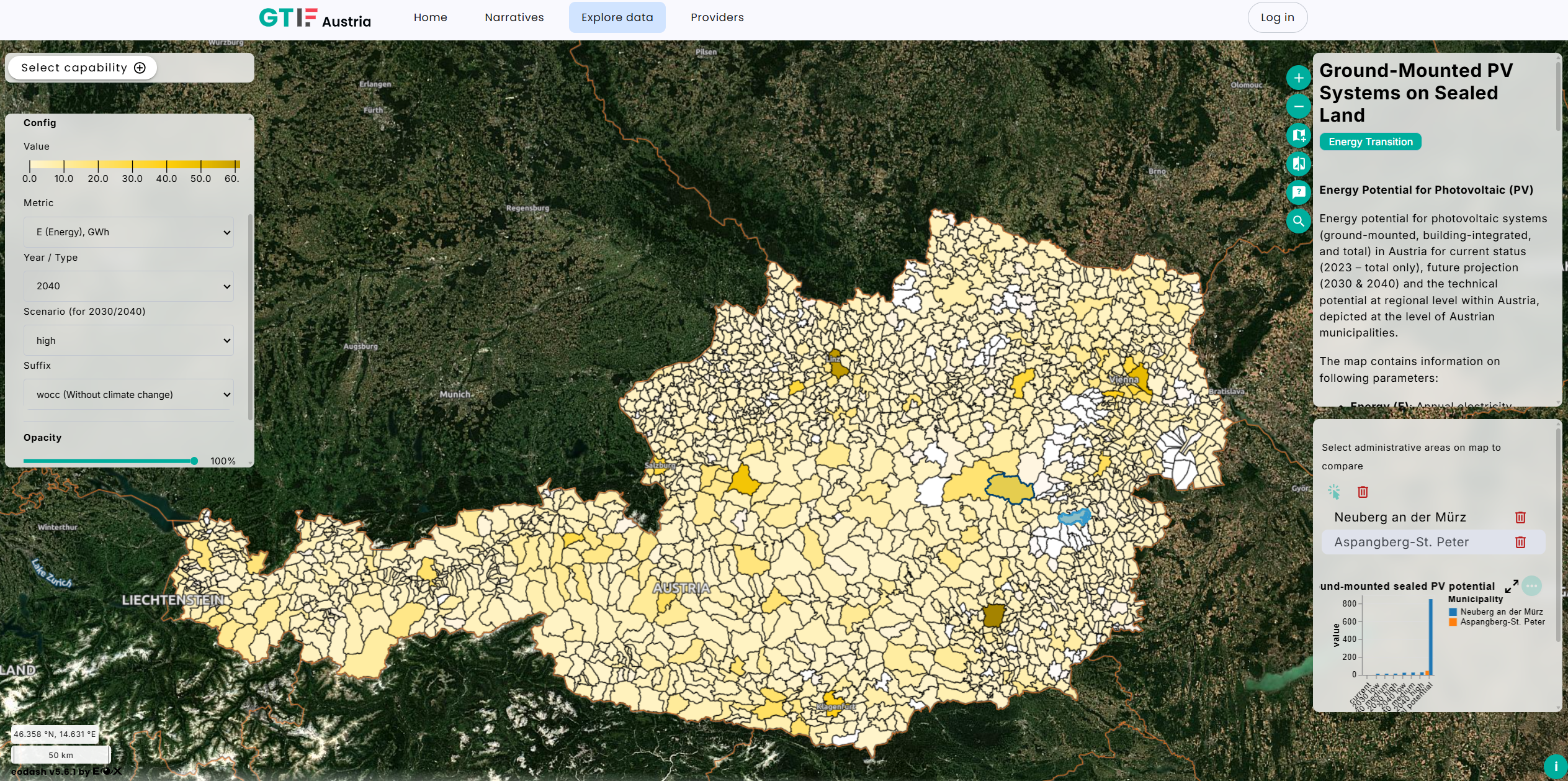
Exemplary excerpt from the GTIF visualisation (map showing PV potential on sealed open areas)
The study shows that Austria has substantial realisable renewable energy potentials for 2030 and 2040. The extent to which these potentials can be exploited is determined less by technical limits than by framework conditions.
Key findings at a glance:
- Electricity: Photovoltaics and wind energy exhibit the largest additional expansion potentials. Photovoltaics can contribute up to around 50 TWh per year by 2040, with a focus on buildings and already sealed surfaces. Wind energy reaches up to around 42 TWh per year, depending on framework conditions. Hydropower remains a central pillar of electricity supply, with additional potentials of up to around 10 TWh per year through optimisation and selective new developments.
- Heat: Particularly large and systemically important potentials exist for ambient heat and shallow geothermal energy, each contributing up to around 20 TWh per year. These are complemented by waste heat, solar thermal energy, and—depending on location—deep geothermal energy.
- Bioenergy: Bioenergy is already a key pillar of Austria’s energy system. The total realisable potential in 2040 amounts to around 59 to 72 TWh per year, with the lower range corresponding roughly to current utilisation levels. While the expansion of total volumes is limited, a shift in use towards process heat, renewable gases, and advanced biofuels is systemically beneficial.
- Buildings and energy infrastructure: Buildings and existing energy infrastructure represent key levers for a land-efficient and publicly accepted expansion of renewable energy. At the same time, further expansion of photovoltaics and wind energy requires consistent grid expansion as well as additional storage and flexibility options.
- Ranges and development pathways: The indicated ranges (Low / Medium / High) for realisable potentials illustrate that the level of target achievement strongly depends on political, economic, and societal framework conditions. While key climate targets are missed in the lower range, the upper range shows that a nearly fully renewable energy supply by 2040 is achievable.
Funding
The study was commissioned by the Austrian Climate and Energy Fund (KLIEN) and funded by the former Federal Ministry for Climate Action, Environment, Energy, Mobility, Innovation and Technology (BMK).