

Municipal roads between expectations and budgets
Roads are among the most visible infrastructures in a municipality – and among the most cost-intensive. In many municipalities, budgets for road maintenance compete with other tasks, such as education, social services, or climate protection measures. Decisions about renovations must therefore be well-founded and sustainable in the long term.
In addition, the municipality, as the road maintenance authority, faces liability issues that arise in the event of accidents caused by poor road conditions.
In addition to traffic safety, the visual and functional condition of roads also plays an important role in the appearance of a town, especially in tourist communities. At the same time, there is a growing demand for sustainable forms of mobility: bike paths and sidewalks must be safe, comfortable, and accessible.
Against this backdrop, it is necessary to create an objective basis for future maintenance measures – independent of subjective assessments and isolated reports.
Condition assessment and evaluation
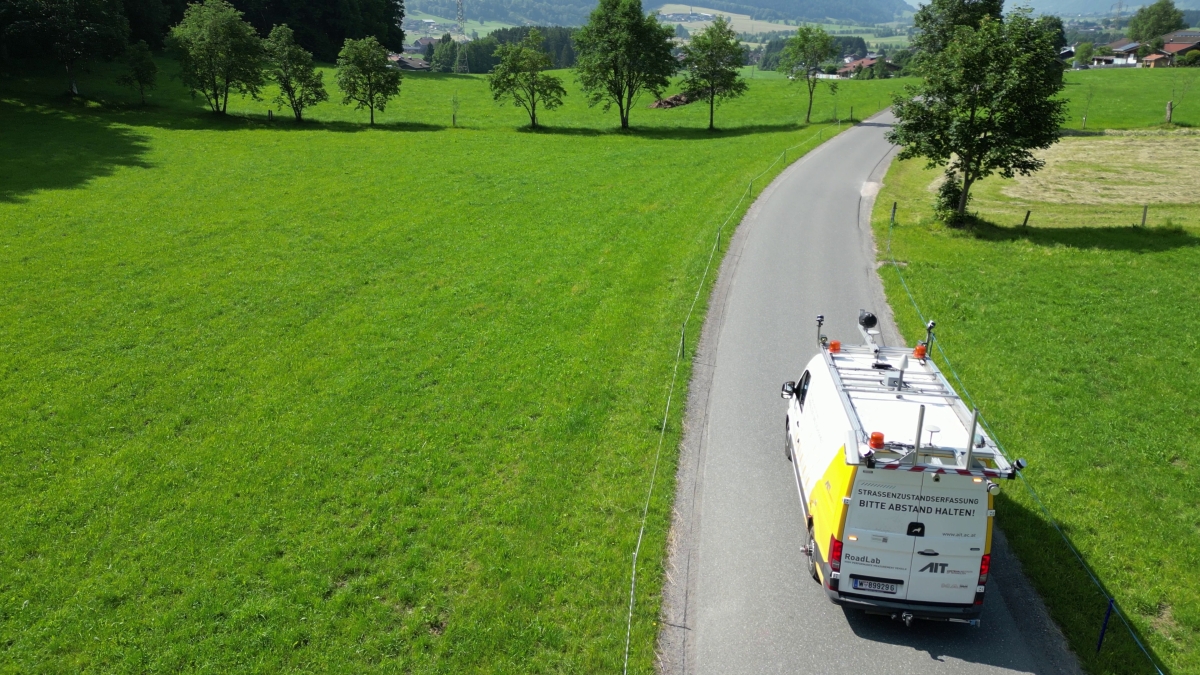
The AIT RoadLab is a compact, flexible platform for the precise recording of road surfaces and road space. It combines state-of-the-art sensor technology, satellite navigation, and high-resolution 4K camera technology. Thanks to its design, it can also be used on narrow side roads or bike paths – a decisive advantage for municipal networks with diverse road cross-sections.
The system documents the entire road width of approximately six meters – not just one lane. This allows all relevant damage to be recorded in full, which significantly reduces the effort required and increases data quality. The subsequent data evaluation is supported by AI methods and provides a comprehensive, objective picture of the condition of the entire network.
The condition of the road surface is documented using high-resolution camera images. Based on current Austrian guidelines, these images are used to record and evaluate the types of damage that are important on municipal road networks.
Single cracks, alligator cracking, spalling, and potholes, patches and repairs, as well as the evenness of the road surface, are assessed for 5-meter sections. A simple scale (no damage/minor damage/severe damage) provides a comprehensible, objective assessment.
The assessments are then used to form 20-meter sections that reflect the condition in the individual damage categories and as an overall value in a school grading system (grade 1 – very good to grade 5 – very poor).
Documentation of the road environment
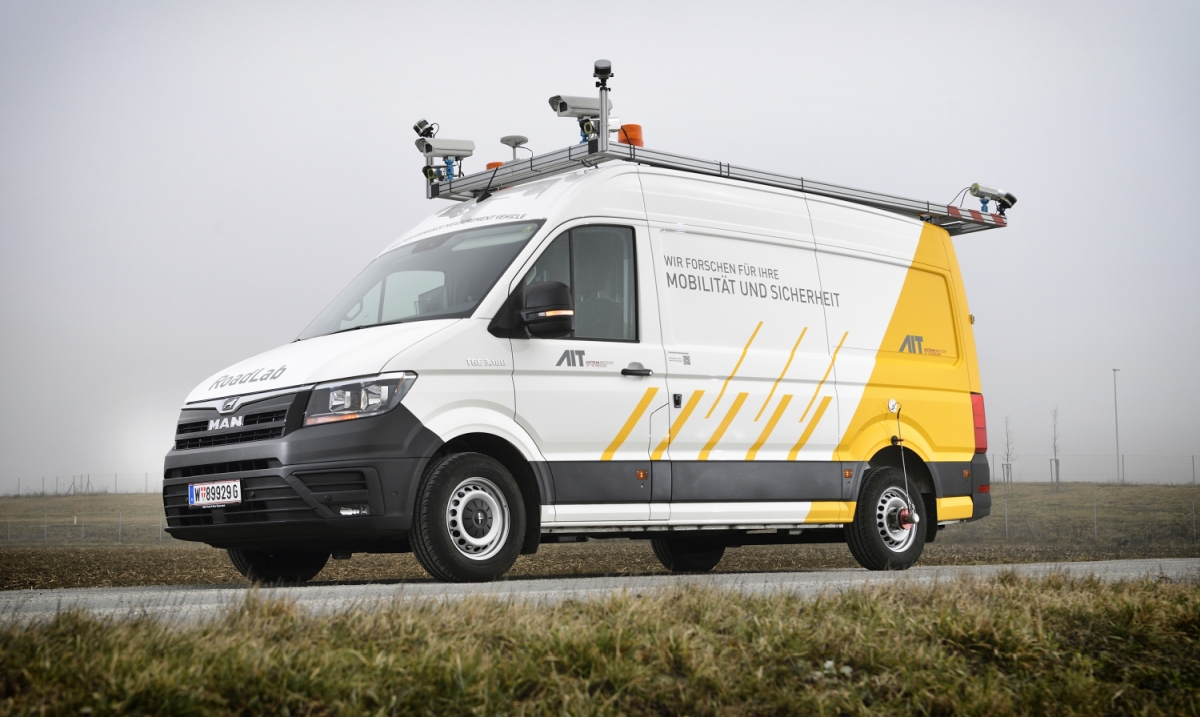
The road environment is documented using high-resolution 4K cameras and a 360° panoramic camera (“StreetView”), with vehicles and pedestrians anonymized in accordance with GDPR. An image is created every 4 meters. With this image documentation, many everyday questions that would otherwise require a site visit can be answered easily and directly in the office.
Data as added value for municipal infrastructure
The damage assessment can be used to derive a list of measures that can be directly incorporated into the budget and construction planning for the coming years.
An additional benefit results from the precise georeferenced recording of damage: the data can be integrated directly into the municipality's own geographic information system (GIS). This creates a valuable basis for further tasks – such as coordinating excavation work by external utilities such as sewer, water, gas, or telecommunications.
Coordinated installation and excavation management based on current status data helps to avoid duplicate excavations, reduce costs, and extend the service life of roads. At the same time, the data can be used as a source of information for citizens – for example, in the interests of transparent administration and freedom of information.