

Taking wire-based additive manufacturing to the next level
Wire-DED – Material, Process, and Data science for future components and Digital qualification
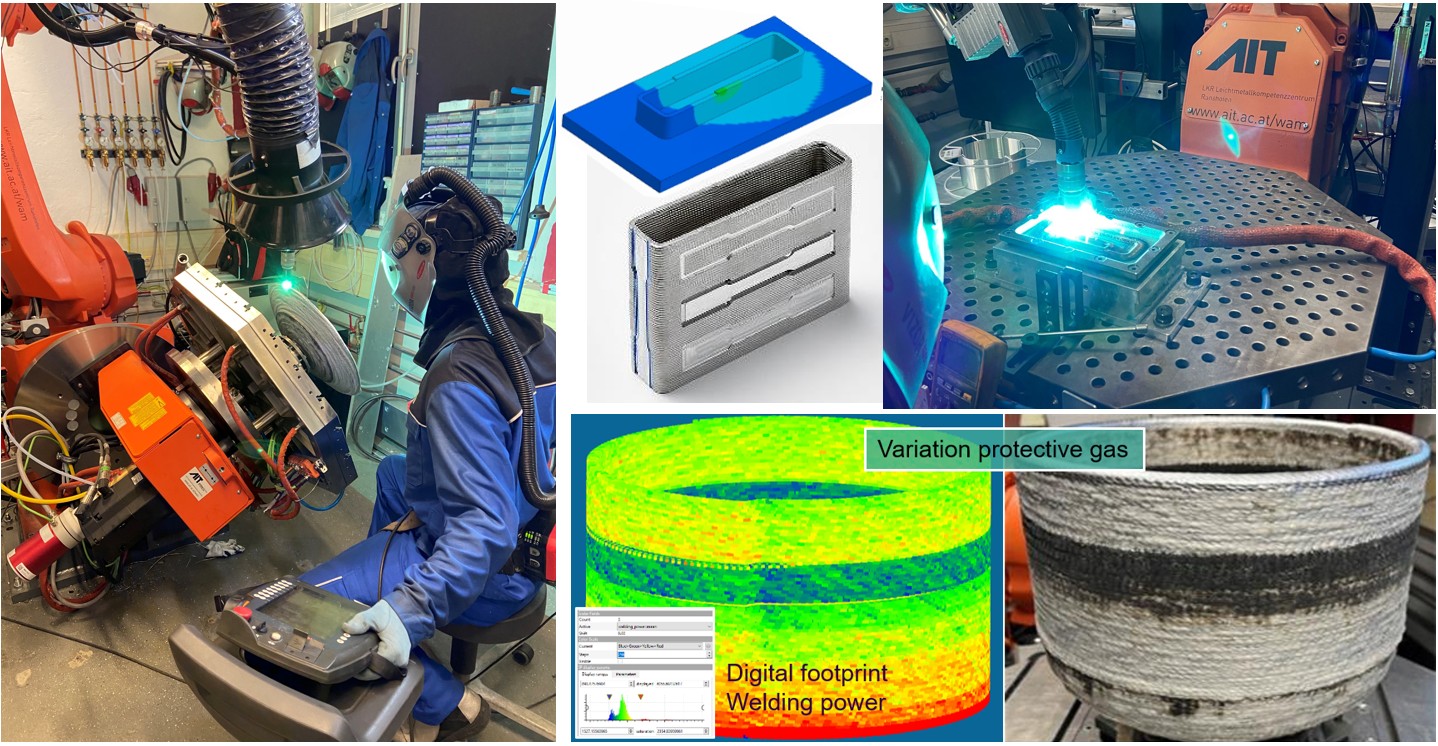
We3D² brings together Austrian and European research and industrial partners to strengthen the competitiveness of industry in the rapidly developing field of additive manufacturing. Building on the knowledge and experience of previous research activities, the project focuses on making wire-based directed energy deposition (w-DED) more flexible, robust, sustainable and digitally enabled.
Under the coordination of LKR Leichtmetallkompetenzzentrum Ranshofen, a broad consortium is working to further develop w-DED for demanding applications in the automotive, aerospace, yellow goods and chemical industries.
We3D²: Towards intelligent and robust additive manufacturing
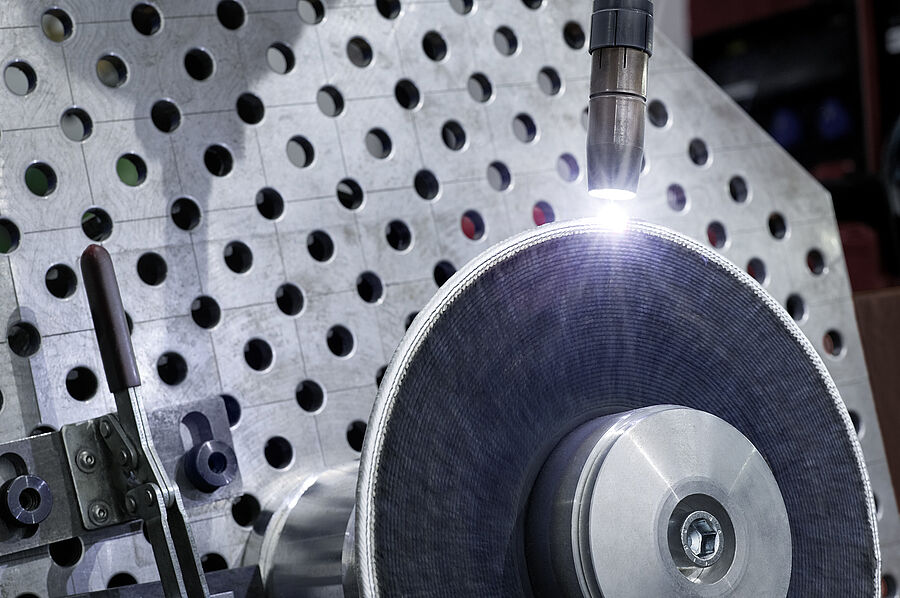
Wire-based directed energy deposition uses welding wire as feedstock to manufacture components layer by layer. The technology combines high deposition rates, efficient material utilization and the possibility of producing large components with comparatively low material waste. This makes w-DED particularly attractive for near-net-shape manufacturing and applications where conventional production routes require substantial amounts of material and machining. However, the transition towards reliable industrial production requires robust processes, suitable materials and a comprehensive understanding of the interactions between material, process, machine and component geometry.
The aim of We3D² is to establish the technological foundations for a new generation of industrial w-DED. The project combines experimental research, simulation, data-driven methodologies and advanced digital technologies through five industrial multi-firm projects and one strategic project.
A key objective is to establish robust processing corridors for relevant material groups and to develop a comprehensive material property portfolio for targeted applications. New and optimized materials will be investigated with the aim of achieving material properties equivalent or superior to conventional wrought counterparts. Another major focus is the digitalization of the manufacturing process. Digital tools will support manufacturers throughout the build job, including advisory systems, height control and machine-condition monitoring. These technologies will contribute to an intelligent 3D printing procedure capable of producing real geometries at lot size one.
From process data to intelligent manufacturing
We3D² places particular emphasis on generating registered and labelled data across the entire manufacturing chain. Material and process parameters, CAD/CAM and simulation data, process-monitoring information and non-destructive evaluation results will be brought together to establish a comprehensive digital knowledge base. This data foundation will support future machine-learning and artificial-intelligence applications for additive manufacturing. New ML/AI and visualization technologies will be developed using an expert-in-the-loop approach, supporting highly qualified personnel rather than replacing human expertise.
Sustainable manufacturing for the future
The development of sustainable production technologies is a central pillar of We3D². By enabling near-net-shape fabrication, w-DED can reduce raw material consumption compared with conventional manufacturing routes. Improved process control, digitalization and optimized manufacturing strategies can further contribute to reducing the environmental footprint of production. Through the combination of advanced materials, robust processing, digitalization and industrial demonstration, We3D² aims to create the foundations for efficient, intelligent and sustainable wire-based additive manufacturing and strengthen the position of Austrian and European industry in the international additive manufacturing market.
COMET: Cooperation between industry and research for the technologies of tomorrow
The COMET Competence Projects for Excellent Technologies programme promotes the establishment of competence centres, the core of which is a high-level research programme jointly defined by business and science. This should provide new research impulses, lead to increased technology transfer and strengthen the innovative capacity of participating companies, resulting in new product, process and service innovations. In this sense, COMET is an essential factor in strengthening Austria as a research and business location.
The consortium would like to thank the Austrian ministry of “Economy, Energy and Tourism (BMWET), the ministry of Innovation, Mobility and Infrastructure (BMIMI), the Austrian Funding Agency (FFG), as well as the three federal funding agencies "Amt der Oberösterreichischen Landesregierung; Steirische Wirtschaftsförderungsgesellschaft m.b.H.; and Wirtschafts-Standort Vorarlberg GmbH for funding project “We3D²” within the 10th COMET-project call.
Further thanks to the industry partners for their financial contributions as well as their spent research contributions in the five conducted multi-firm projects.
Consortium
Industrial partners
Aardworx GmbH
AVL List GmbH
Flottweg SE
Fronius International GmbH
Hammerer Aluminium Industries
Liebherr-MCCtec GmbH
Linde Gas GmbH
MAGMA Gießereitechnologie Ges. für Gießerei- Simulations- und Regeltechnik mbH
Magna Steyr Fahrzeugtechnik GmbH & Co KG
MPC2 GmbH
Nemak Europe GmbH
RHP-Technoloy GmbH
robotized rm systems GmbH
Schoeller-Bleckmann Nitec GmbH
Scientific partners
LKR Leichtmetallkompetenzzentrum Ranshofen GmbH
AIT Austrian Institute of Technology GmbH, Center for Vision and Automation, Control
Technische Universität Graz, Institute of Materials Science, Joining and Forming
Materials Center Leoben Forschung GmbH, Department Materials
RISC Software GmbH