


AIT develops AI platform for industrial production
Secure and easily integrable AI is designed to make it easier for SMEs to adopt smart and resource-efficient production processes
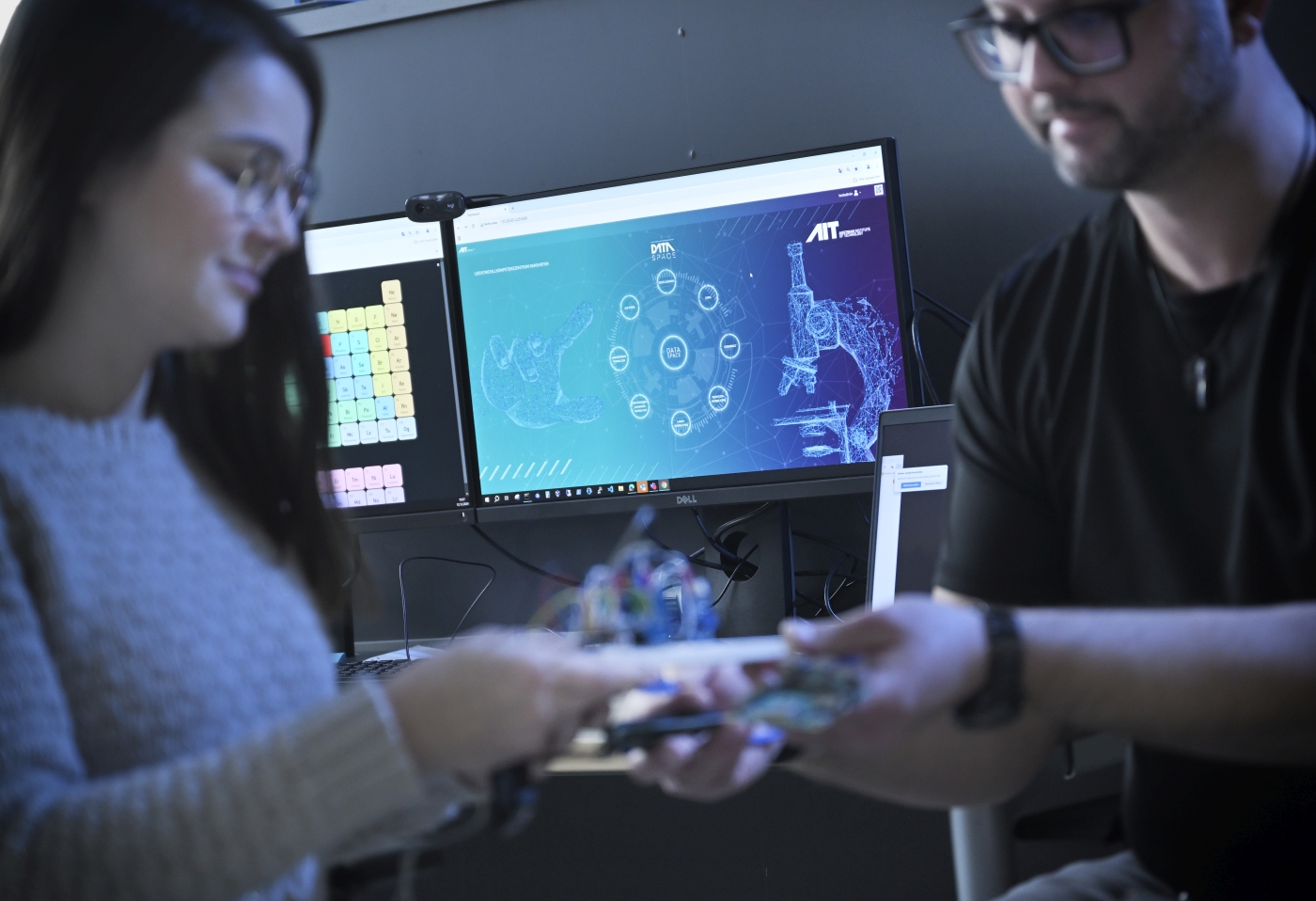
AIPCell – Artificial Intelligence-driven Production Cell – is a modular and secure AI platform designed to facilitate the use of artificial intelligence in industrial production environments, particularly for small and medium-sized enterprises (SMEs). Coordinated by the LKR Leichtmetallkompetenzzentrum Ranshofen at the AIT Austrian Institute of Technology, the AIPCell consortium is developing an end-to-end solution ranging from high-frequency data acquisition, through machine learning pipelines and AI models, to real-time processing directly at the production line. The technology is being trialled in the fields of casting, forming and printed circuit board production. The project also takes into account the requirements of industrial IT/OT environments as well as regulatory frameworks such as the EU AI Act.
The challenge: Significant barriers to industrial AI
Artificial intelligence offers great potential for making production processes more efficient, resilient and resource-efficient. For many SMEs, however, getting started involves significant technical, financial and organisational hurdles. There is often a lack of specialist AI expertise, suitable data infrastructures and standardised processes for data collection, data preparation, model training and the ongoing operation of AI applications. Added to this are issues relating to costs, cloud resources, IT/OT integration and legal requirements.
At the same time, modern production facilities generate large volumes of high-frequency data – for example, from acoustics, vibrations, image processing and machine control systems. In many cases, this data potential for quality monitoring, anomaly detection and predictive maintenance has not yet been fully exploited.
Project objective: A seamless infrastructure for industrial AI
AIPCell aims to reduce these barriers to entry through an edge/cloud-based production environment. ‘Edge AI’ refers to the processing and execution of AI models directly on or near the production machine, for example on a local industrial PC or a specially developed edge device. This enables production data to be processed with very little delay, and AI-supported decisions to be made immediately within the process. At the same time, large volumes of data do not need to be transferred in full to a central cloud.
The project is developing an end-to-end machine learning pipeline that supports the collection, preparation, annotation and analysis of production data, as well as the training and deployment of AI models. Another key focus is on the development of two AI modelling techniques and the use of pre-trained models. Through cross-domain learning, existing models are to be adapted to new use cases, thereby reducing training effort, data requirements and costs.
The AI methods developed are intended, in particular, to help detect critical process conditions at an early stage, automatically identify quality deviations and support preventive maintenance.
AIT’s contribution: Research for industrial applications
The LKR contributes its domain expertise, industrial demonstrators and existing data infrastructure, and is responsible for project coordination. Key tasks include the development and integration of hardware and software for data acquisition, the establishment of an edge/cloud-based data and machine learning environment, and data acquisition, processing and modelling.
In doing so, the project can draw on existing expertise in AI-supported quality assurance as well as existing research infrastructure. Among other things, traditional approaches to feature selection will be combined with modern methods based on convolutional neural networks (CNNs) and recurrent neural networks (RNNs) and tested on in-house casting and forming equipment.
Three industrial applications
The technology developed is being validated using three demonstrators: magnesium continuous casting, deep drawing and printed circuit board assembly. The aim is to demonstrate that the methods developed and the technical infrastructure can be transferred to different production environments.
In the long term, both the data and AI environment and the data acquisition solutions and models developed are intended to be usable for further research and industrial projects. AIPCell is thus creating a technological foundation on which companies can gradually expand AI applications without having to build a completely new infrastructure for every new use case.
Michael Denk, researcher at the LKR Leichtmetallkompetenzzentrum Ranshofen, sums it up: “With AIPCell, we bring AI directly to where value is created – at the machine. Our vision is a production system that understands its own context and utilises precisely those AI models it needs at that very moment. High-frequency sensor technology and processing directly within the production process make anomalies immediately visible and enable intelligent decisions in real time. This makes industrial AI accessible to SMEs too, flexible in its application and usable without the need for a large in-house AI infrastructure.”
Consortium and Funding
The project coordinator LKR Leichtmetallkompetenzzentrum Ranshofen des AIT Austrian Institute of Technology. The consortium comprises TTTech Industrial Automation AG, blackcore GmbH, Elektro Kreutzpointner GmbH, MARK Metallwarenfabrik GmbH, ViCOS GmbH, LARsys-Automation GmbH und Know Center Research GmbH.
AIPCell is funded under the FFG call for proposals ‘Resource Transition 2025 – Circular Economy and Production Technologies’ (KLWPT 24/26) issued by the Federal Ministry for Innovation, Mobility and Infrastructure (BMIMI) and is administered by the Austrian Research Promotion Agency (FFG). The project will run for 30 months, from 1 May 2026 to 31 October 2028. The published project funding amounts to 1,444,913 euros. The FFG project ID is 5145720.