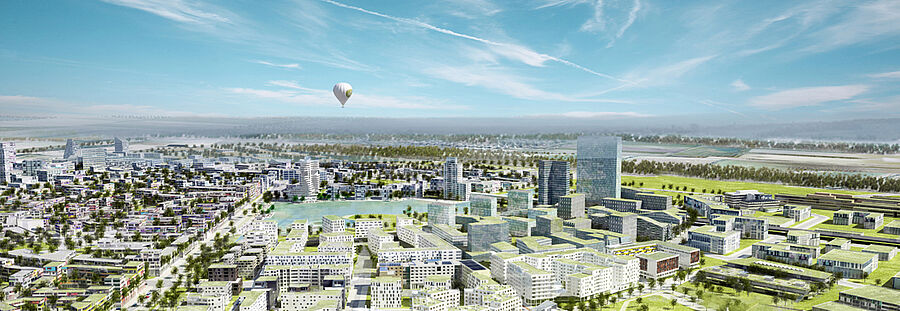


The growing challenges posed by climate change call for a fundamental transformation of urban spaces. The pioneering city of Schwechat has already implemented numerous climate-related measures in areas such as renewable energy, energy efficiency, sustainable mobility, and urban planning. Previous approaches were often sector-specific and isolated; the exploratory project “Rathausquartier 2040” now pursues an integrated, holistic approach with the goal of creating a sound planning basis for the transformation of the town hall district toward climate neutrality and resilience. As an economic and social hub, the district is ideally suited for testing innovative solutions in a real-world, multifunctional context, as the pilot project deliberately focuses on municipally owned buildings and public open spaces. As part of the climate neutrality roadmap, the project serves to prepare the groundwork for a demonstration project.
The innovation lies in the cross-sectoral methodology: Instead of considering energy planning, building renovation, and open space design in isolation, we bring these areas together in an integrated overall concept. A technological focus is on establishing passive energy networks (low-temperature systems) in existing buildings to enable efficient heating and cooling. By utilizing state-of-the-art simulation technologies from the City Intelligence Lab (CIL) at AIT, we can assess the impact of construction measures on the microclimate and the quality of the built environment (e.g., thermal comfort, pedestrian simulations).
Project Goals
In close coordination with urban decision-makers, a shared vision is developed that unites previous individual initiatives into a systemic overall concept. The continuous involvement of local stakeholders ensures that the project remains anchored in existing structures and guarantees high social acceptance. In parallel, the technical and economic feasibility of the developed energy supply options is evaluated. Using simulation-based analyses, the domains of energy, buildings, and open space are examined in detail to validate the effectiveness of structural and energy-related measures. In addition, viable financing strategies and business models are developed to guarantee the economic implementation of the planned transformation. This is followed by concrete implementation planning and the preparation of a demonstration project. To provide long-term, sustainable impetus for the neighborhood’s transformation, the potential of “tactical urbanism” and “placemaking” is explored as early as this phase. The results of this exploration lead to a roadmap for implementation, including a timeline, cost estimate, and financing options. Based on this, a potential collaborative R&D project is designed.
Funding Scheme
The call for proposals “Technologies and Innovations for the Climate-Neutral City” is part of the “Climate-Neutral City” R&D priority of the Federal Ministry for Innovation, Mobility, and Infrastructure (BMIMI) and the Climate and Energy Fund (KLIEN). The call is being administered on behalf of the BMIMI and KLIEN by the Austrian Research Promotion Agency (FFG) in collaboration with Austria Wirtschaftsservice Gesellschaft mbH (AWS).
FFG Website: https://klimaneutralestadt.at/de/projekte/tiks/rathausquartier-2040.php