

How can excavators, cranes, and forklifts become true field robots—robust, efficient, and above all safe? The key is an integrated robotics architecture that covers the full chain: perception → motion planning (navigation & path planning) → motion control → verifiable safety & decision logic. Only if these components interact reliably under changing real-world conditions does automation become practical at scale.
This is exactly where our current research at AIT Austrian Institute of Technology partly in cooperation with TU Wien and Tufts University contributes: from LiDAR-based 3D perception to collision-free, sway-damping MPC-based motion control, and learning-enabled planning with safety constraints enforced at all times.
Copyright: AIT/tm-photography
Presentation to the scientific community
We bundle these topics into six scientific papers, presented at ICRA 2026 (June 1–5) in Vienna. The IEEE International Conference on Robotics and Automation (ICRA) is one of the world’s leading conferences in robotics and automation, bringing together international research, industry, and innovation.
Public presentation
Want to see what this looks like in practice? At the Festival of Robots (Karlsplatz, May 30–31) we will demonstrate our autonomous work machines live and share insights into further developments in large-scale robotics.
More information coming soon via the AIT Large-Scale Robotics Lab: https://www.ait.ac.at/labs/large-scale-robotics-lab and the Festivals website: https://www.roboterinwien.com/
As AIT, we reinforce our position in the automation of work machines, focusing on practical, field-ready solutions for construction, logistics, forestry, and agriculture.
6 papers – 6 building blocks for autonomous work machines
1) 3D perception directly from LiDAR point clouds
Paper: PIRATR: Parametric Object Inference for Robotic Applications with Transformers in 3D Point Clouds by M. Schwingshackl, F.F. Oberweger, M. Niedermeyer, J. Huemer, M. Murschitz. https://arxiv.org/abs/2602.05557
Video: https://youtu.be/vR_BrmPzVeo
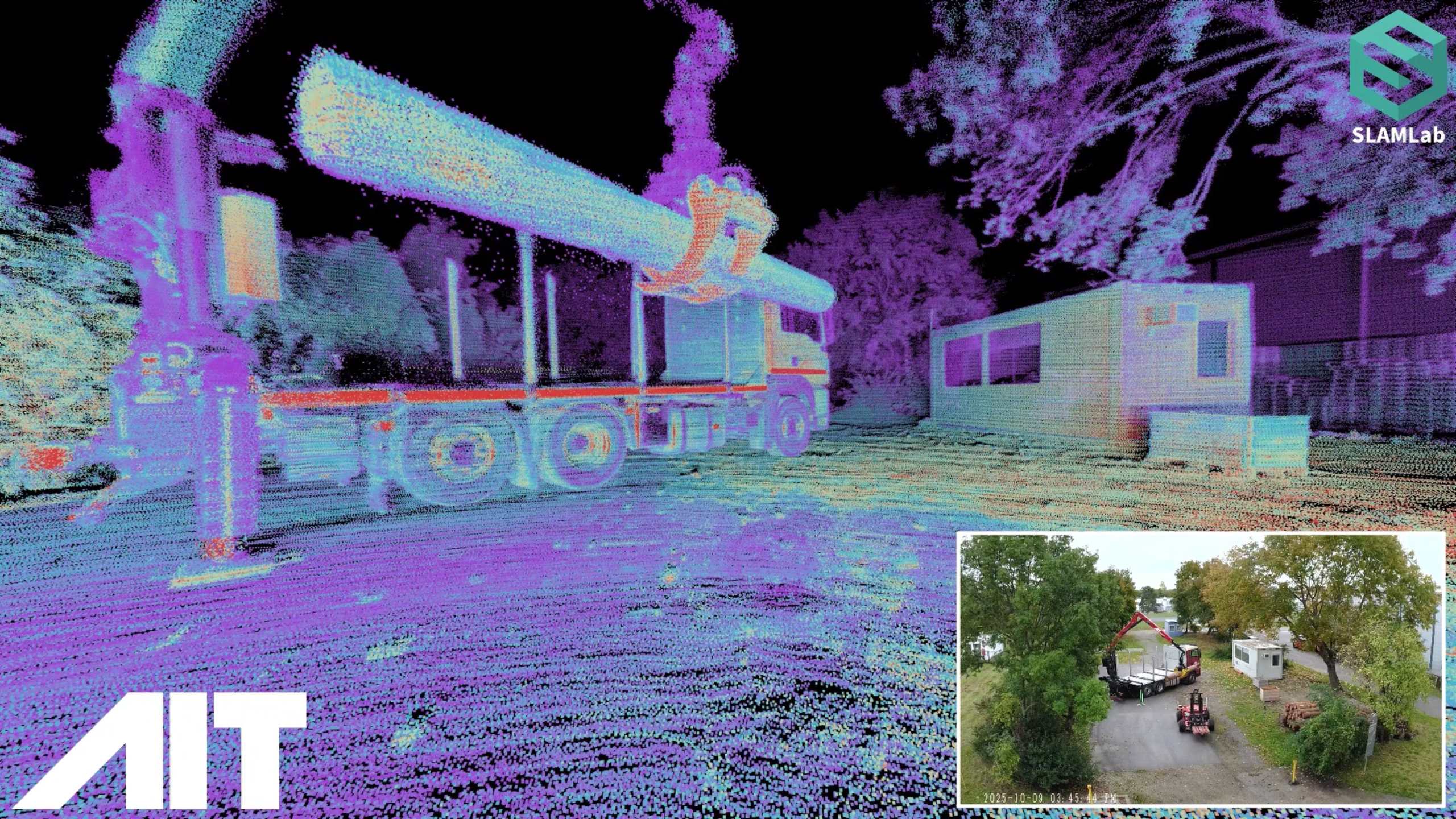
With PIRATR, we present an end-to-end trained AI system for 3D object inference from laser scan data. It detects objects directly in point clouds and estimates both their 6D pose (position + orientation) and object-specific parameters. This enables parametric descriptions of variable objects—e.g., estimating the opening angle of a crane grab. The approach is demonstrated on pallets, loading platforms, and crane grabs. PIRATR is trained exclusively on synthetic data and transfers reliably to real outdoor LiDAR scans.
Why it matters: Accurate pose and state estimation is a key enabler for robust automation and safe interaction between autonomous machines.
2) Crane automation: Precise placement despite pendulum dynamics
Paper: Autonomous Block Assembly for Boom Cranes with Passive Joint Dynamics: Integrated Vision MPC Control by G. Ebmer, M.N. Vu, T. Glück, W. Kemmetmüller. https://arxiv.org/abs/2603.00103
Video: https://www.acin.tuwien.ac.at/42d7/
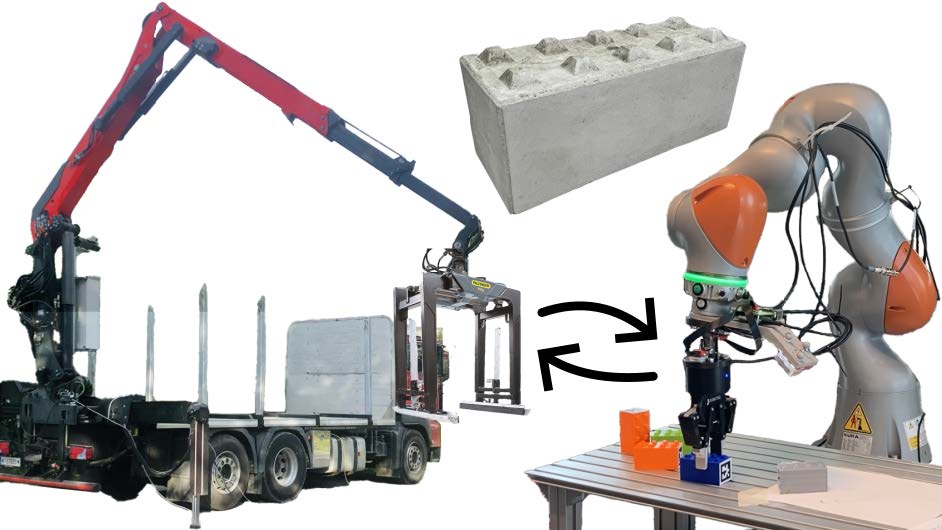
Automating the placement of prefabricated building components requires reliable precision—especially for boom cranes with passive joint dynamics, where pendulum-like sway makes accurate placement difficult. Our framework integrates real-time vision-based pose estimation, collision-aware B-spline planning, and nonlinear MPC (NMPC) into a closed loop that enables autonomous pick-and-place assembly and obstacle avoidance. The approach is validated on a laboratory-scale testbed that emulates crane kinematics and passive dynamics. The collision-aware planner generates feasible B-spline references in real time on CPU hardware with anytime performance, while NMPC actively suppresses sway and tracks the planned trajectory under continuous vision feedback.
Why it matters: Construction automation needs the combination of real-time perception, collision-free planning, and active sway damping to achieve reliable placement in dynamic, cluttered environments.
3) Safety in the field: Collision-free sway damping for forestry cranes
Paper: A Collision-Free Sway Damping Model Predictive Controller for Safe and Reactive Forestry Crane Navigation by M.-P. Ecker, C. Fröhlich, J. Huemer, D. Gruber, B. Bischof, T. Glück, W. Kemmetmüller. https://arxiv.org/abs/2602.10035
Video: https://youtu.be/tEXDoeLLTxA
In unstructured environments such as forests, timber loading cranes must both avoid collisions and actively damp load sway. We present a model predictive controller that combines both objectives in a single control problem. The key is integrating LiDAR-based environment mapping directly into the MPC via online Euclidean distance fields (EDF). Experiments demonstrate effective sway damping and reliable obstacle avoidance, including controlled safe stopping when no evasive maneuver is feasible.
Why it matters: Safety must be enforced by the controller itself—robustly, in real time, even under disturbances and changing surroundings.
4) Learning & optimization: Flexible motion with safety enforced at all times (SafeFlowMPC)
Paper: SafeFlowMPC: Predictive and Safe Trajectory Planning for Robot Manipulators with Learning-based Policies by T. Oelerich, G. Ebmer, C. Hartl-Nesic, A. Kugi. https://arxiv.org/abs/2602.12794
Video: https://www.acin.tuwien.ac.at/en/42d6
Code: https://github.com/TU-Wien-ACIN-CDS/SafeFlowMPC
Outside traditional industrial settings, autonomous machines need flexibility and real-time responsiveness. Learning-based policies can generalize from demonstrations, but often lack rigorous safety guarantees; optimization methods provide guarantees, but can be less flexible. SafeFlowMPC combines flow matching (learning from demonstrations) with real-time MPC-based online optimization: the learned policy proposes motions, and MPC continuously checks and corrects them so that hard safety constraints are enforced at all times, even in dynamic scenarios. The approach is validated in three real-world experiments on a KUKA 7-DoF robot (two grasping tasks and a dynamic human-robot handover).
Why it matters: Work machines must adapt to changing conditions without violating safety distances or motion/force/workspace limits—SafeFlowMPC combines adaptability with verifiable safety.
5) Autonomous racing as a test field: Toward the optimal driving line via control feedback
Paper: Spatially-Aware Adaptive Trajectory Optimization with Controller-Guided Feedback for Autonomous Racing by A. Wachter, A. Willert, M.-P. Ecker, C. Hartl-Nesic. https://arxiv.org/abs/2602.15642
Video: https://www.acin.tuwien.ac.at/7rac
Autonomous racing is about improving the ideal line lap after lap—faster, more precise, and still stable to drive. This closed-loop approach plans a trajectory and then refines it over repeated runs using feedback from the controller. Tracking deviations are treated as informative signals about local track and vehicle behavior, producing an adaptive map of permissible accelerations that makes the driving line progressively faster and more robust—even under changing grip conditions.
Results: 17.38% lap-time reduction in simulation; 7.60% improvement on real hardware across different tire compounds—without explicitly modeling friction.
Why it matters: The principle can be transferred to autonomous machines with recurring processes: learning from execution deviations can make motions more robust and efficient over time.
6) Reliable autonomy over long task chains
Paper: The Price Is Not Right: Neuro-Symbolic Methods Outperform VLAs on Structured Long-Horizon Manipulation Tasks with Significantly Lower Energy Consumption by T. Duggan, P. Lorang, H. Lu, M. Scheutz. https://arxiv.org/abs/2602.19260
Many autonomous systems are already good at performing individual motions. Things get challenging when tasks consist of many consecutive steps – such as "find object → grasp → transport → align → place" – and where each step must build correctly on the previous on.
This is precisely where this paper comes in, comparing two fundamentally different approaches to autonomy:
• VLA (Vision-Language-Action): an end-to-end AI system that derives the next actions directly from image and language information.
• Neuro-symbolic architecture: a combination of symbolic task planning (sequence of steps, rules, checks) and learned low-level skills that reliably execute the individual movements.
Result: For structured, long task chains, the neuro-symbolic approach is more reliable and at the same time more energy-efficient.
Why it matters: Work-machine autonomy often consists of long, rule-based process chains (e.g., pick up, transport, position, set down). Explicit, comprehensible task logic combined with robust execution skills can significantly improve reliability and efficiency—making autonomy dependable in everyday operation.