


A research team led by the AIT Austrian Institute of Technology is presenting its paper “Conformal Cross-Modal Active Learning” at CVPR Findings 2026. The “IEEE Conference on Computer Vision and Pattern Recognition” (CVPR) is one of the world’s leading conferences in computer vision and AI-based image analysis. Together with colleagues from TU Wien and RWTH Aachen University, the researchers have developed a new methodological approach that combines active learning with modern vision-language models (VLMs). In active learning, an AI model selectively chooses the data points that provide the greatest value for annotation and learning. Vision-language models process visual and textual information jointly, enabling a deeper semantic understanding of visual content.
The new approach aims to reduce the effort required to annotate large image datasets by specifically selecting the most relevant training examples. This enables AI models for autonomous and robotic systems to be trained more robustly and efficiently.
“Last summer, during a discussion with my colleague Cédric Jung, we realized an interesting gap: while active learning has been widely explored, its integration with vision-language models (VLMs) remains largely underexplored. This sparked a simple but challenging question: how can we bring active learning into the multimodal VLM setting? Over the following months, we explored many directions, faced quite a few dead ends, and got stuck more times than we’d like to admit. But eventually, we found a way forward by bridging vision and language through a conformal, cross-modal framework”, says Huy Hoang (Eric) Nguyen. He and Cédric Jung conduct research in the Complex Dynamical Systems group at AIT and are pursuing their PhDs at TU Wien in close collaboration with AIT.
Reducing the data effort required for AI training
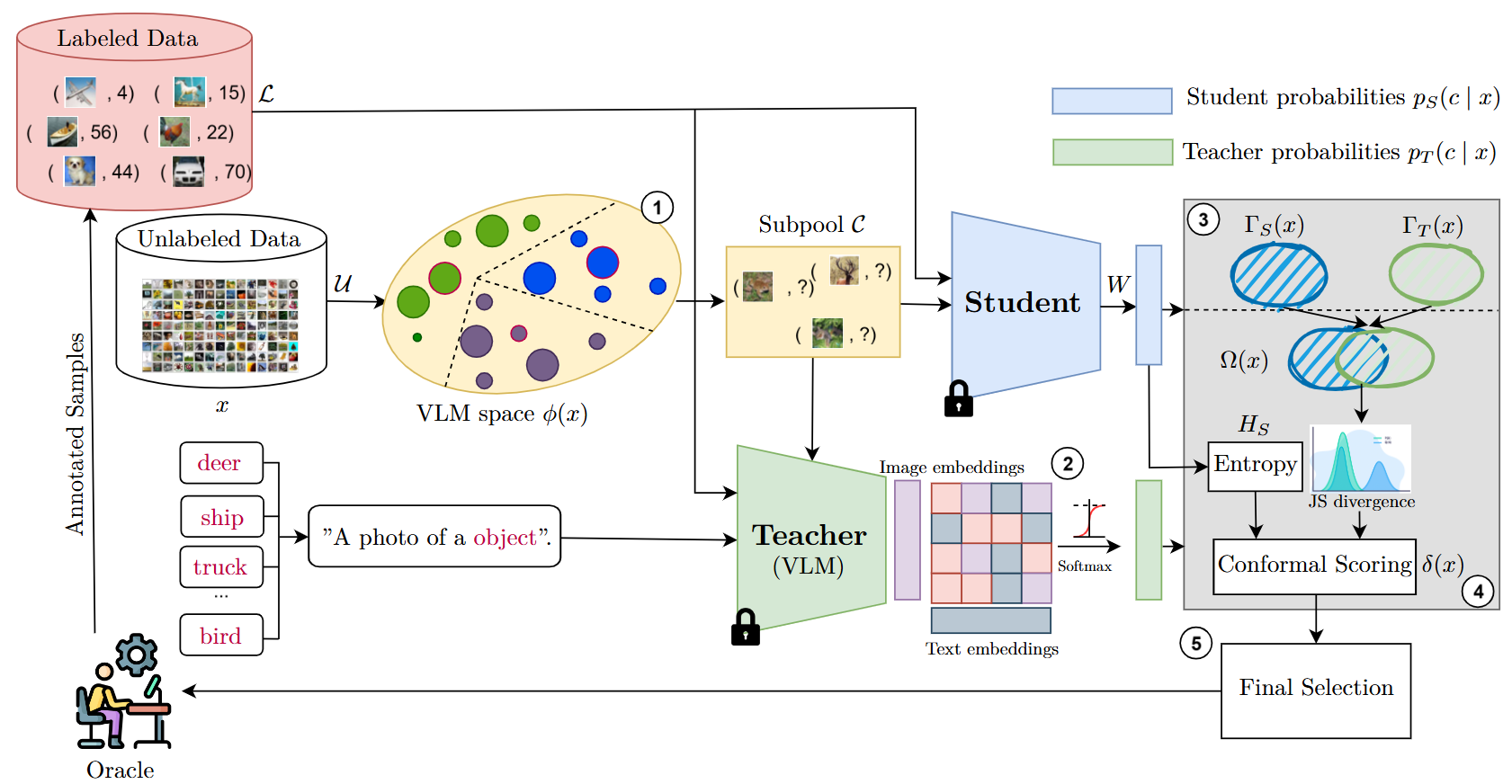
With “Conformal Cross-Modal Acquisition” (CCMA), the research team has developed a new active learning approach that uses pretrained vision-language models specifically to select highly informative training data. This refers to images or examples from which an AI model can learn particularly well — for example because the model is still uncertain about them, because they are especially representative of a class, or because they cover new variants and situations. Unlike conventional methods, which usually focus only on visual uncertainty, CCMA combines multimodal uncertainty estimation with a deliberate selection of diverse data. This means that the method does not choose many similar images, but rather examples that reflect different objects, perspectives, environments, or appearances. To achieve this, a vision-language model acts as a “teacher” working together with a visual model as a “student”; their assessments are combined through conformal calibration so that especially relevant data points can be identified more precisely. This makes AI training processes more efficient and robust.
Why combining modalities improves learning
Another key contribution of the work is a better understanding of when multimodal support delivers the greatest benefit in the learning process. The results show that the approach is particularly effective when the teacher and student models differ meaningfully in their assessment of training data over several learning rounds. These differing assessments provide additional information that enables a more targeted and efficient selection of relevant data.
International visibility for AIT research in robotics and image processing
With the inclusion of the paper in the CVPR Findings 2026, AIT’s research in computer vision, multimodal machine learning, and data-efficient AI for robotics is gaining further international visibility.
Read the scientific paper:
“Conformal Cross-Modal Active Learning”; Huy Hoang Nguyen, Cédric Jung, Shirin Salehi, Tobias Glück, Anke Schmeink, Andreas Kugi. https://arxiv.org/pdf/2603.23159https://arxiv.org/pdf/2603.23159
Code: https://github.com/Eric-nguyen1402/CCMA