


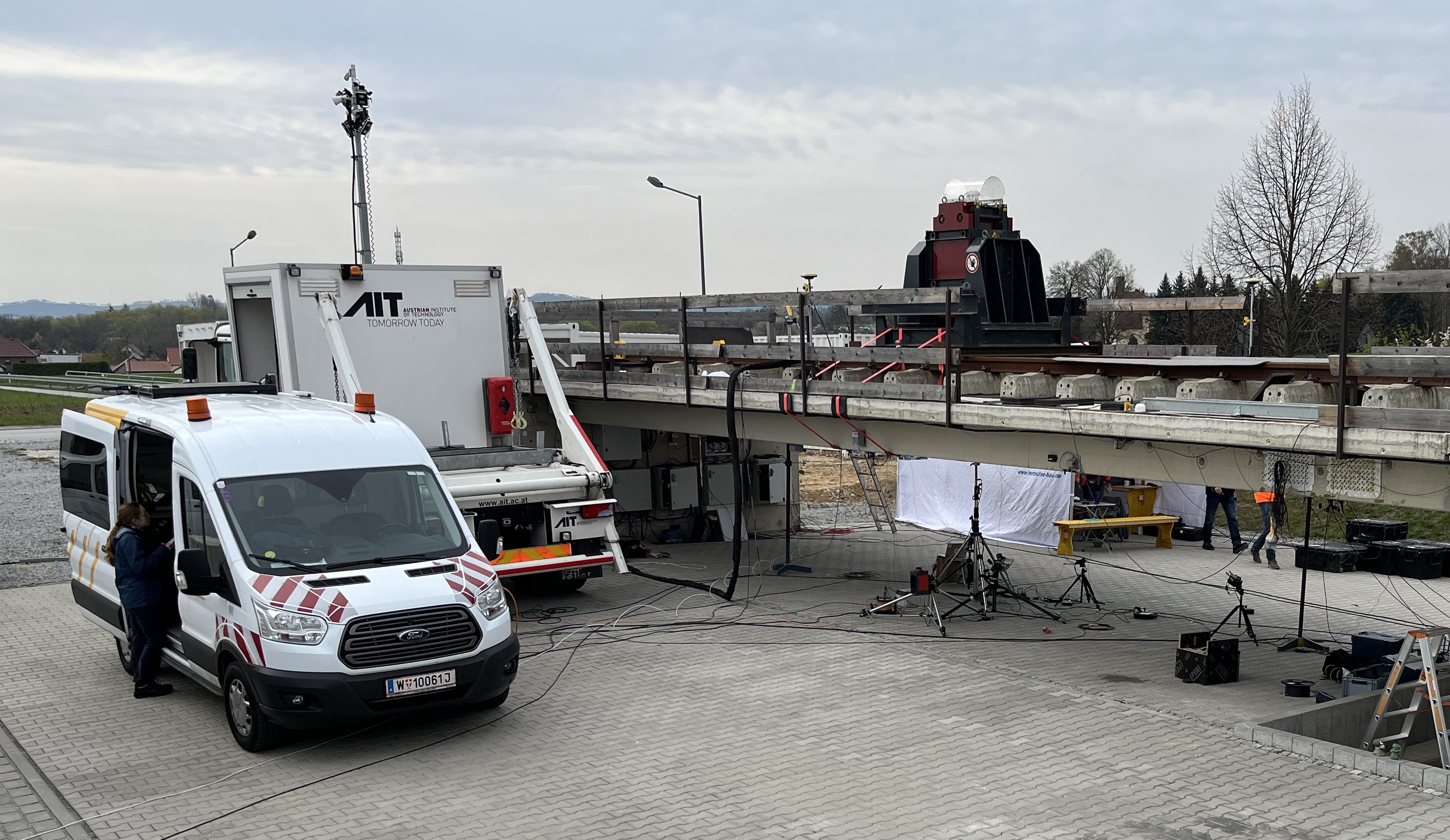
In mid-April, the AIT Austrian Institute of Technology carried out extensive dynamic tests on the openLAB research bridge in Bautzen as part of the FOSsure research project. The AIT’s Mobile Seismic Simulator (MoSeS) was used for this purpose, exposing the bridge to specific dynamic loads over several days. The aim of the test series was to investigate the influence of dynamic loads on both the structure itself and modern measurement and monitoring systems.
The openLAB research bridge, operated by Dresden University of Technology and Hentschke Bau, is a test facility unique in Europe that offers ideal conditions for large-scale investigations in the field of structural health monitoring. During the tests, the AIT used the MoSeS to generate a wide variety of harmonic and variable excitations in both vertical and horizontal directions, as well as simulated traffic loads. In parallel, numerous research institutions and industry partners carried out measurements using different sensor technologies directly on the structure.
The FOSsure project focuses on the use of distributed fibre optic sensors (Distributed Fibre Optic Sensing, DFOS) for the continuous and holistic monitoring of civil engineering structures. The aim is to develop scientifically sound measurement, analysis and assessment concepts to enable the early and reliable detection of damage and changes in the condition of structures. The data obtained during the openLAB trials provides a unique basis for this. “The use of distributed fibre optic sensors marks a paradigm shift in the monitoring of reinforced concrete structures, as this technology allows cracks in the concrete to be monitored reliably and cost-effectively,” explains Vazul Boros, project manager at AIT.
In addition to the AIT, the measurement campaigns involved, amongst others, TU Dresden, TU Graz, the University of Rostock, the Federal Institute for Materials Research and Testing (BAM), the Fraunhofer Institute IIS, Hentschke Bau, FOLAB and SuessCo.