


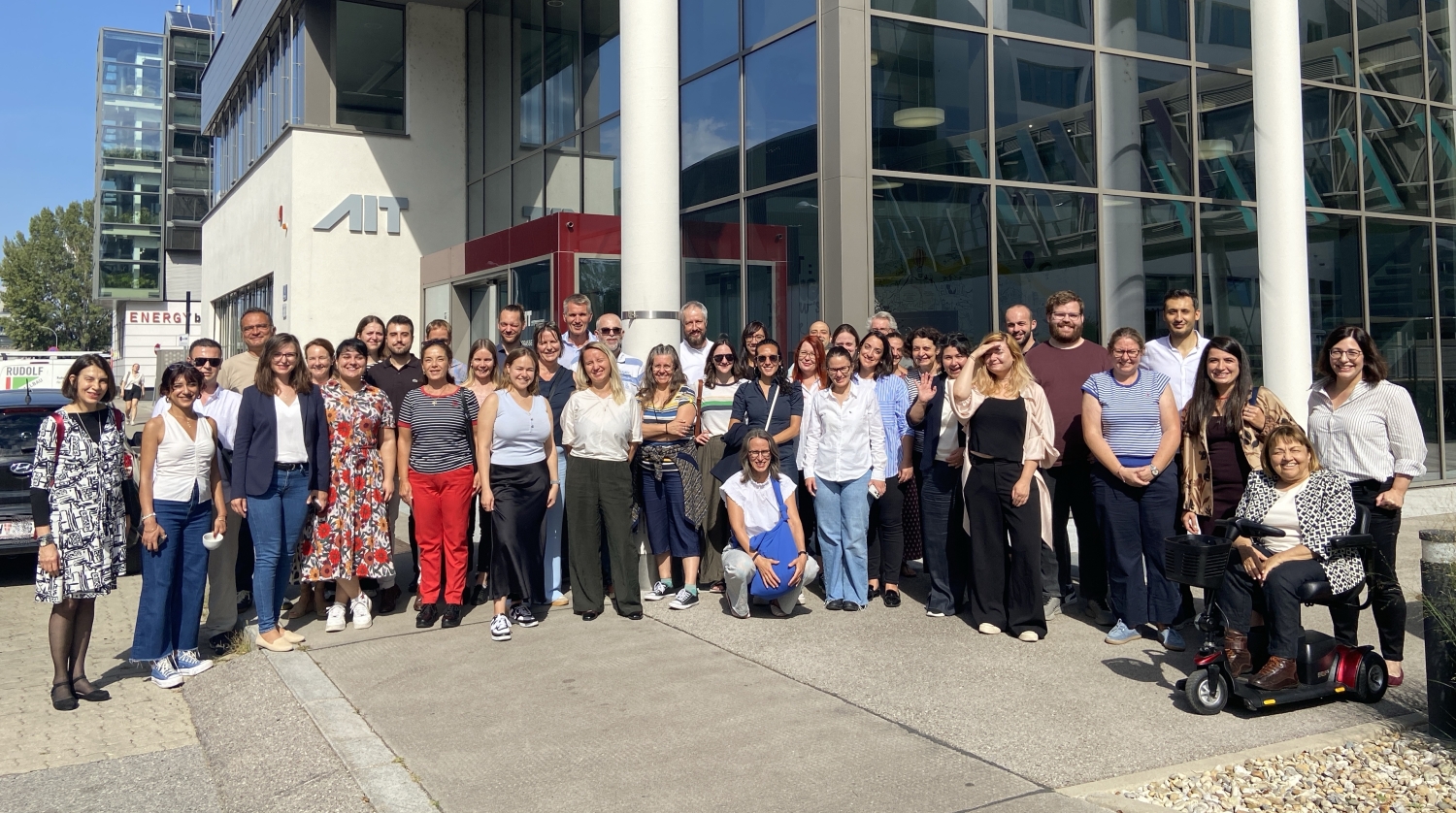
Representatives of the 28 project partners from 16 European and associated countries met at AIT in Vienna on 9 and 10 September to prepare for the final phase of the Horizon Europe project AMIGOS (Active Mobility Innovations for Green and Safe Solutions). Funded by the European Union, the project runs from June 2023 to May 2027 and supports cities in developing, implementing and evaluating innovative solutions for safer, more sustainable, inclusive and accessible urban mobility. To this end, AMIGOS works in five Living Labs, ten Safety Improvement Areas and five Twin Cities across Europe.
From Challenge to Concrete Solution
Over the past project years, concrete mobility measures have been developed and implemented in the participating cities. These include, for example, the transformation of Hlemmur Square in Reykjavík into a pedestrian-oriented mobility hub, accessibility improvements on walking and cycling routes in Bologna, safer school environments in Lappeenranta and Jūrmala, sustainable mobility campaigns in Gabrovo, new cycling infrastructure in Ankara, and a multimodal mobility hub in Las Rozas. There, new cycling connections are being created around a commuter railway station, accessibility is being improved, and interactions between pedestrians and vehicles are being made safer.
The measures were developed together with citizens, local authorities and particularly vulnerable road users. This made it possible to tailor the solutions specifically to local challenges and actual mobility needs.
Data Shows the Impact of the Measures
To evaluate the implemented solutions, AMIGOS combines different data sources and digital technologies. These include AIT’s Mobility Observation Box (MOB), mobility data from the Fotefar and SPOR apps, municipal datasets, a Big Data Platform and Digital Twins. For example, the MOB collected detailed traffic data in the Safety Improvement Areas – ranging from school zones and intersections to pedestrian areas and multimodal transport hubs.
During the meeting, the partners discussed how these data can be brought together within a common evaluation methodology. The aim is to assess the impact of the measures on road safety, accessibility, environmental performance, mobility behaviour and quality of life in a comparable way. As leader of the impact assessment activities, AIT coordinates this evaluation and the comparison of results from the different pilot cities.
Making Experiences Useful for Other Cities
Another key focus is on making successful solutions useful for other cities as well. The experiences from the Living Labs and Safety Improvement Areas are intended to show which measures can be transferred to other urban contexts and integrated into future mobility planning. In this way, AMIGOS also aims to contribute to sustainable and future-oriented mobility concepts beyond the lifetime of the project.
Insights into AIT’s Research Infrastructure
In addition to the project workshops, participants visited AIT’s research infrastructure in the field of Transportation Infrastructure Technologies. Among other things, the Mobility Observation Box and the measurement vehicles RoadSTAR, RoadLAB and MoProVe were presented. The demonstrations showed how modern sensor technology, high-resolution infrastructure monitoring and AI-based traffic analysis can be used to support data-driven decisions on road safety and sustainable mobility. Isabela Erdelean, AIT project manager concluded: “By establishing a robust evaluation methodology and identifying scalable solutions, the final phase of the project will provide practical guidance for cities seeking to accelerate the transition towards greener, safer and more inclusive urban mobility systems”.