


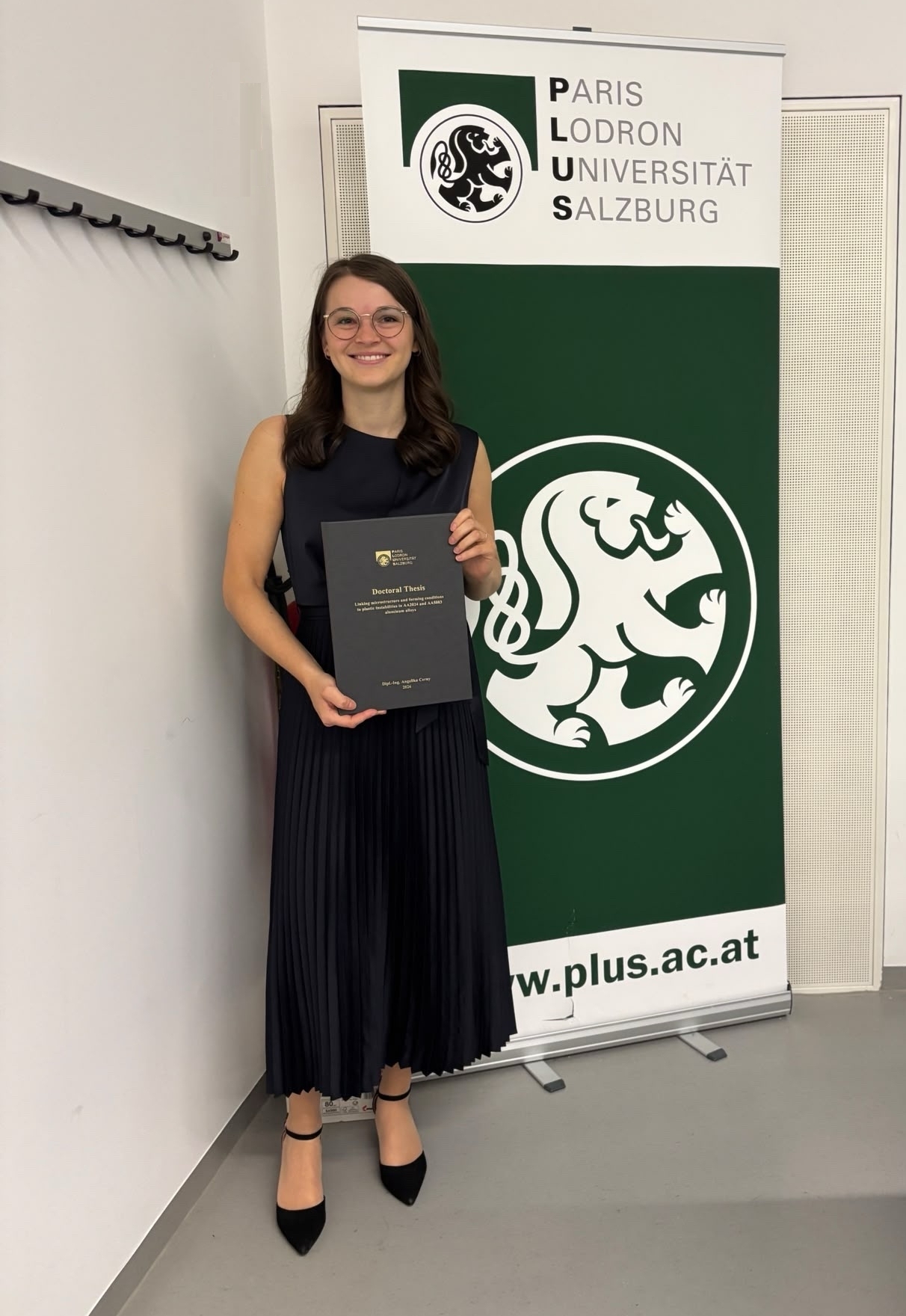
A major success for Angelika Cerny, a researcher at the LKR Light Metal Competence Centre Ranshofen of the AIT Austrian Institute of Technology: she has completed her PhD at the University of Salzburg with distinction. In her thesis, she investigated how microstructure, thermal history and forming conditions influence the formability of aluminium alloys.
Angelika Cerny completed her PhD at the Faculty of Natural and Life Sciences at the University of Salzburg, in the Department of Chemistry and Physics of Materials. Her thesis was supervised by Univ.-Prof. Dr Nicola Hüsing. The external examiners were Univ.-Prof. Dipl.-Ing. Dr mont. Stefan Pogatscher and Prof. Dr Randi Holmestad.
Her doctoral thesis is entitled “Linking microstructure and forming conditions to plastic instabilities in AA2024 and AA5083 aluminium alloys”. The thesis focuses on the question of how the formability of aluminium alloys can be specifically improved – an important aspect for resource-efficient and high-performance lightweight construction.
A particular focus was on the AA2024 alloy. Using atomic probe tomography and transmission electron microscopy, Angelika Cerny investigated how natural ageing and pre-treatments influence the formation of ultrafine precipitates. These microstructural changes have a direct impact on the thermal and mechanical behaviour of the material.
Another area of focus was the so-called Portevin–Le Chatelier effect (PLC), a plastic instability that can occur during forming and impair the formability of aluminium alloys. In her work, Cerny developed a method for quantitatively assessing the intensity of this effect as a function of temperature and strain rate.
Furthermore, she investigated electrically assisted forming as an alternative to conventional hot forming. The results show that electrical pulses can partially suppress the PLC effect at comparatively low temperatures whilst simultaneously increasing the elongation at break.
The thesis thus combines fundamental materials science with application-oriented issues in metal forming and provides important insights for the further development of efficient lightweight construction processes.
We offer our warmest congratulations to Dr Angelika Cerny on this outstanding achievement!