


(c) AIT
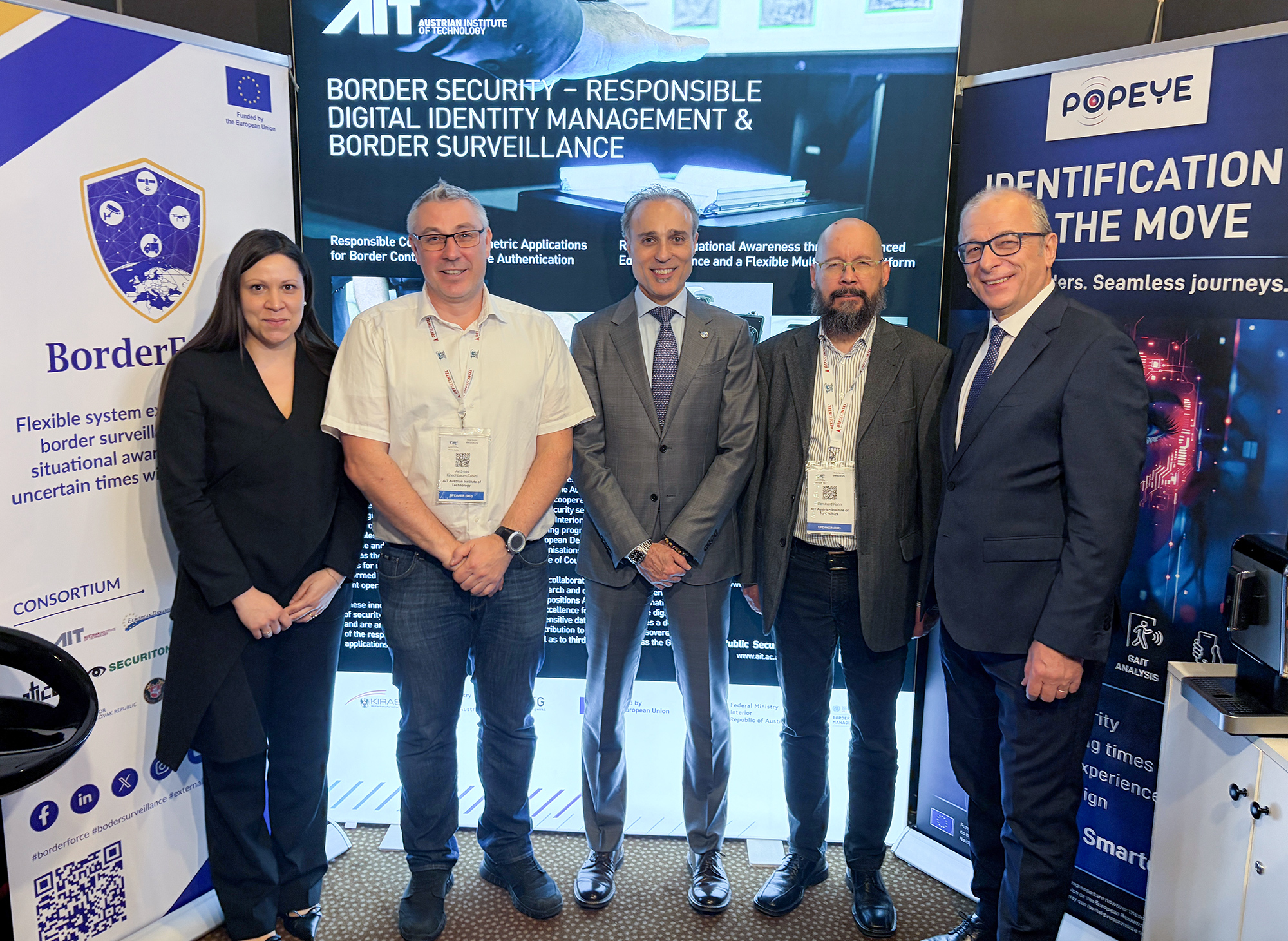
At the World Border Security Congress 2026 in Vienna, experts from the AIT Austrian Institute of Technology, together with representatives from the Federal Ministry of the Interior and the United Nations Office of Counter-Terrorism (UNOCT), presented innovative solutions for contactless biometric identity systems. The close collaboration between researchers, stakeholders, and international organizations underscores Austria’s growing role as a “best practice” example for the responsible use of digital technologies in security-critical contexts.
The contactless biometric solutions developed at AIT enable efficient and user-friendly acquisition of biometric data—for example, via mobile devices. They thus make a concrete contribution to the modernization of identity verification and are already being used in practice by security authorities. The focus is on reliable and robust capture of biometric features, ease of use in operational settings, and the consistent implementation of Security-by-Design and Privacy-by-Design principles. In this way, the solutions address key requirements for secure and trustworthy identity verification processes.
Beyond technological development, AIT is also engaged in international capacity building in collaboration with UNOCT: Through workshops and training programs worldwide, authorities and organizations are supported in building expertise for the responsible use of biometric technologies. The focus is on how biometric technologies can be used in a legally compliant and responsible manner—for example, through clear rules for handling sensitive data, transparent processes, and a better understanding of the practical impacts of these technologies in real-world applications. In this way, the joint activities contribute to UNOCT’s international support efforts in the field of border security and management.
As part of the congress, AIT experts, together with their partners, also organized several technical presentations. In the Technology Workshop, Andreas Kriechbaum-Zabini (AIT), together with Jozef Kubinec (Ministry of the Interior, Slovak Republic) and Rocco Messina (UNOCT), presented the paper “BorderForce: Innovation in Border Surveillance with Advanced Technologies,” which highlighted new approaches to technological support for modern border surveillance.
Another highlight was the presentation “Best Practice Austria – Smart Contactless Biometric Application,” in which Bernhard Kohn (AIT), together with Reinhard Schmid (Federal Criminal Police Office) and Margherita Natali (UNOCT), presented concrete applications and experiences from Austria. This clearly demonstrated how innovative research solutions can be successfully translated into operational use.
These presentations and discussions at the World Border Security Congress impressively demonstrated how technology-driven and needs-based innovation, international cooperation, and a clear focus on responsible use work together to establish secure and trustworthy digital solutions in a global context.
Further information: