

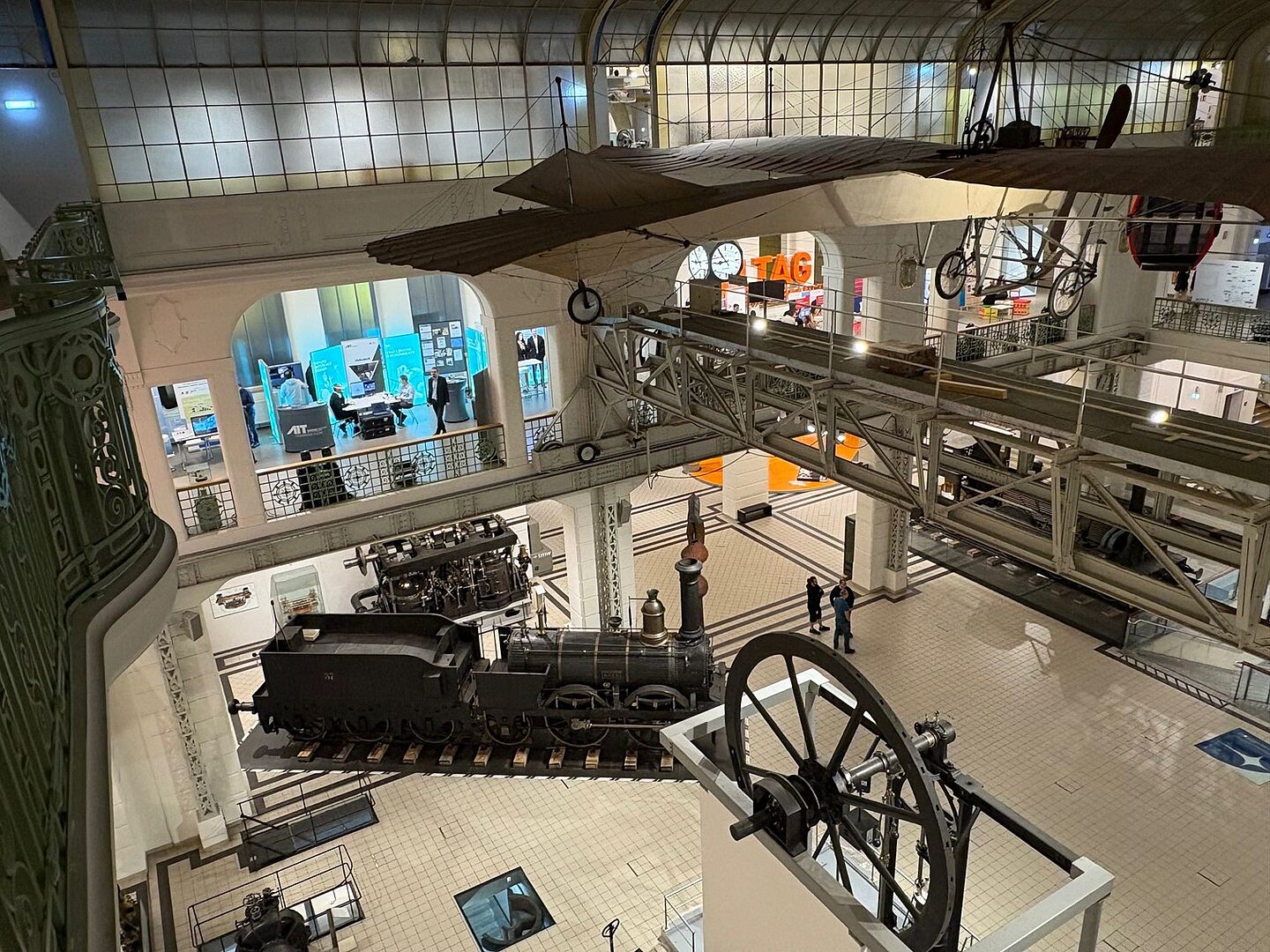
Das AIT ist wie in den vergangenen Jahren wieder Partner der Digital Days und mit einem Stand im Technischen Museum vertreten.
The AIT Austrian Institute of Technology will be presenting AI innovations with social, economic and environmental impact at Digital Days. Markus Murtinger and Ross King will be speaking on stage.
Under the motto “Technology Race. Human Race”, the main day of Digital Days will take place on 18 November 2026, once again at the Vienna Technical Museum. AIT has been a partner of Digital Days and the City of Vienna for many years and will be showcasing a broad spectrum of current AI research at its stand – ranging from human-centered language support in nursery schools, through privacy-friendly AI in public transport, to AI-supported cataloguing of historical library collections. Furthermore, the AIT will be well represented on stage as part of the conference program by Markus Murtinger, Deputy Head of the Centre for Technology Experience, and Ross King, Head of the Data Science & AI Competence Unit at the Centre for Digital Safety & Security.
Hands-on human-AI experience
At the AIT stand, three interactive stations bring the concept of the human-AI experience to life.
WISPER – AI-based language support in nursery schools: WISPER (Vienna Language Experience) is an AI-based language support solution for three- to six-year-olds in nursery schools, developed by the City of Vienna – Nursery Schools in collaboration with the AIT Centre for Technology Experience. A child-friendly telephone (user experience) enables children whose mother tongue is not German to learn German through play. With the help of WISPER, children can develop a story at their own pace. WISPER understands any language but always replies in German. Language support staff from the City of Vienna were involved in the development right from the start (user-centered design). The solution takes some of the pressure off the language support teachers and specifically complements their work. And most importantly: children love it. As a reward, the children receive a picture of the story from the printer built into the phone. In Vienna, 26,000 children in nursery schools have language support needs (out of a total of 88,000 children). WISPER was awarded the eAward in the ‘Education and Social Affairs’ category. https://www.ait.ac.at/en/research-topics/experience-measurement/projects/wisper
Measuring emotions and experience factors using automated facial expression analysis: This method provides insights into how people experience technology emotionally and cognitively by directly analysing facial expressions. There are many potential applications here: whether for market research, product development or UX, in healthcare and customer service, or even in e-learning programmes.
Automated chatbot testing with AI personas: A test framework for conversational AI and agentic AI, developed at the AIT, tests chatbots automatically and at scale.
These demo stations reflect the research carried out by the AIT Center for Technology Experience led by Manfred Tscheligi. The researchers are dedicated to the topic of collaboration between humans and AI with one overarching goal: AI systems should provide people with optimal support and be enjoyed by users. AIT combines traditional user experience research with the specific challenges of modern AI systems, focusing on human-centered AI design, the measurement of experience and trust, and context-aware interaction across various sectors such as manufacturing, energy, healthcare and the public sector. At AIT TX.Lab, participatory approaches such as co-creation, interviews and focus groups are employed, alongside experimental development, prototyping and field studies. In addition, physiological measurement methods such as eye-tracking and bio signal measurements are also used.
Artificial Intelligence in the Service of Society
The AIT Center for Digital Safety & Security is presenting three current research projects at the AIT booth:
AI4PT – Privacy-Preserving AI for Sustainable Transport: In this project, funded by the FFG (AI for Green 2023 Call), AIT is working with Indicate Digital and Siemens Mobility Austria to develop AI solutions that predict and optimize passenger distribution and flows in public transport. The aim is to increase the capacity and appeal of public transport, for example on underground lines that already operate at high frequency. To this end, cost-optimized, camera-based systems with integrated object recognition (SmartCams) are linked to sensor data from underground trains and further developed using federated learning to create privacy-compliant, predictive AI models for underground operations. https://www.ait.ac.at/themen/data-science-artificial-intelligence/projekte/ai4pt
ONiT – Ottoman Nature in Travelogues, 1501–1850: The interdisciplinary ONiT project, funded by the Austrian Science Fund (FWF), analyses text-image relationships in digitized travelogues about the natural world of the Ottoman Empire, in collaboration with the Austrian Academy of Sciences (ÖAW) and the Austrian National Library (ÖNB). Using multimodal deep learning methods such as OpenCLIP, historical prints and texts have been automatically catalogued. The freely accessible ONiT Explorer makes over 22,000 historical images from around 2,000 travelogues in the ÖNB’s collections – in German, English, French and Latin – searchable. https://labs.onb.ac.at/en
Machina Emblematica: The AIT’s AI-powered chatbot and research system (a RAG system) makes historical text and image collections – including the 1668 edition based on works by Joachim Camerarius – accessible in modern language. Users can ask questions about content, motifs, symbolism or classical sources in German or English, without needing to know Latin or Greek. The AIT developed the technical architecture that combines vector-based image and text search with large language models (LLMs) and is working at the interface between artificial intelligence and cultural heritage. https://machina.ait.ac.at
Jasmin Lampert, Pascal Thiele, Michela Vignoli, Christine Wahlmüller-Schiller, Raimund Schatz and Dominika Fabsits will be at the AIT booth at the Technical Museum.
Digital Days 2026
Main day with exhibition and conference: 18 November 2026
Venue: Vienna Technical Museum, 1140 Vienna
https://digitalcity.wien/event/digital-days-2026-2

- +43 664 88390690
- +43 50550-2201
- christine.wahlmueller-schiller(at)ait.ac.at