


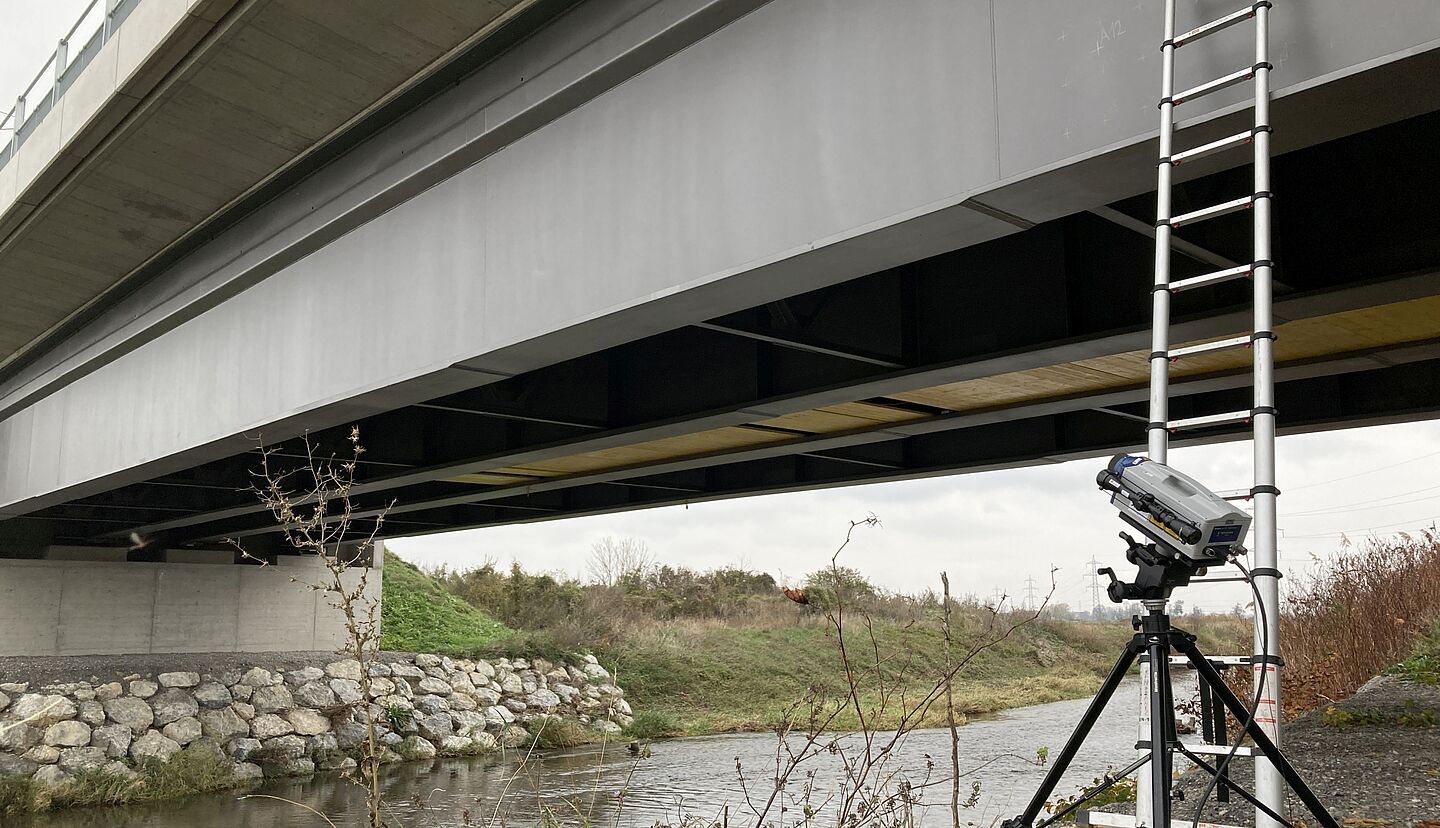
Brückenmessung
22 European partners are developing new materials, technologies and digital methods for sustainable and resource-efficient transport infrastructure: four demonstration projects in Austria, France, Germany and Hungary are testing these solutions under real-world conditions.
How can Europe’s transport infrastructure remain safe, efficient and sustainable in the long term in the face of climate change, scarce resources and increasing environmental requirements? This is the question being addressed by the new European research and innovation project MATTERS (Materials and Technologies for Enduring, Resilient, and Sustainable Transport Infrastructure). Coordinated by the AIT Austrian Institute of Technology, 22 organisations from the fields of research, academia, infrastructure management and industry are working to develop and test in practice innovative construction materials, sustainable repair methods and digital assessment tools for roads, railways and waterways. The four-year project began on 1 October 2026 and is funded with around 11 million euros as part of the EU’s Horizon Europe research programme. Four large-scale demonstration projects along trans-European transport corridors (TEN-T) in Austria, France, Germany and Hungary are set to demonstrate the practical viability of the solutions developed.
Europe’s transport infrastructure faces new challenges
Europe’s transport networks form a key foundation for mobility, economic development and security of supply. At the same time, roads, bridges, railway lines and waterways are under increasing pressure to be renewed and adapted. Many infrastructure assets are already several decades old and need to be maintained, modernised or replaced in the long term. Added to this are the consequences of climate change: more frequent and intense heatwaves, heavy rainfall events and other extreme weather conditions are placing greater strain on infrastructure and imposing new demands on its planning, operation and maintenance.
Furthermore, the production and processing of conventional building materials, as well as construction and maintenance work, are often associated with high energy and resource consumption and corresponding CO₂ emissions. At the same time, large quantities of materials are consumed, which are often not reused after demolition. Furthermore, there is still a widespread lack of comprehensive assessment frameworks that allow the evaluation of the sustainability and resilience of individual structures to be systematically applied at the level of entire transport networks.
What is therefore needed are new approaches that take both environmental and technical requirements into account: infrastructure should not only be durable and safe, but should also be planned, built and maintained using fewer primary raw materials, with lower emissions and a stronger focus on the circular economy and climate adaptation.
MATTERS: Holistic solutions across the entire life cycle
This is precisely where MATTERS comes in. The project adopts a holistic life-cycle approach that takes into account all phases of transport infrastructure – from planning and construction, through operation and maintenance, to decommissioning and reuse. Building on research findings already validated in the laboratory, new materials, engineering methods and digital tools are being further developed, combined and demonstrated under real-world conditions.
The focus is on several areas of technological development:
- Low-carbon concrete: Development and testing of concrete using alternative binders and a high proportion of recycled aggregates. The aim is to reduce the use of primary raw materials and the emissions associated with concrete production.
- Bio-based asphalt: Development of sustainable asphalt binders and asphalt mixes that reduce the use of fossil raw materials and open up new possibilities for a more environmentally friendly road infrastructure.
- Innovative repair methods: New technologies and methods are intended to extend the service life of existing infrastructure and reduce the need for resource-intensive new construction.
- Circular economy and reuse: ‘Reuse-by-design’ approaches ensure that, right from the planning stage, consideration is given to how components can be recovered and reused at the end of their service life. Digital Product Passports are intended to make relevant material and component information available throughout the life cycle.
- Nature-based solutions: Concepts for integrating nature-based solutions (NbS) are intended to help better protect infrastructure from climatic and natural impacts whilst simultaneously delivering positive benefits for ecosystems.
These developments are complemented by an integrated assessment framework for sustainability and resilience. This framework is designed to translate data from individual infrastructure assets into quantitative assessments at the level of entire transport networks. A modular digital toolkit will make it possible to compare different technical solutions and to make informed decisions regarding planning, maintenance and investment.
The technologies and concepts developed will be tested at four demonstration sites along European TEN-T corridors. The aim is to validate their technical and practical applicability up to Technology Readiness Level 7 (TRL 7). This means that functional prototypes will be demonstrated under real operating conditions. The aim is to successfully bridge the gap between research and application. In the long term, the project results are also intended to be incorporated into standardisation and into guidelines for sustainable public procurement (Green Public Procurement).
AIT: Intelligent condition assessment, long-lasting bridges and innovative climate models
As project coordinator, the AIT Austrian Institute of Technology plays a central scientific and technological leadership role. In addition to overall coordination, the AIT is specifically responsible for the scientific oversight and implementation of the European demonstration projects. In terms of content, the research focuses on the intelligent condition assessment of infrastructure, extending the service life of existing structures, the reuse of building components, and taking future traffic and climate-related stresses into account.
A key focus is on the development of innovative monitoring and assessment methods based on distributed fibre-optic sensing (DFOS). This technology enables the continuous measurement of deformations and mechanical stresses along fibre-optic sensors (glass fibres). This allows condition data to be obtained across the various life-cycle phases of a structure and used to assess its continued serviceability.
Another key area of research concerns the repair of existing bridges. This involves investigating technologies based on ultra-high-performance concrete (UHPC) in combination with corrosion-free textile reinforcement. These materials and construction methods offer the potential for particularly durable and high-performance repair solutions. As part of the MATTERS project, they are being optimised and assessed in terms of their technical properties, their applicability to the existing bridge stock and their carbon footprint.
To ensure the long-term resilience of transport infrastructure, we must take into account today the stresses to which structures will be exposed in the coming decades. To this end, AIT is developing site-specific load models that incorporate both changing traffic conditions and future temperature effects. This involves combining virtual sensing, traffic simulations and climate scenarios.
The project is also investigating the effectiveness of nature-based protective measures. These include, for example, afforestation measures and biotechnologically stabilised embankments, which can help to stabilise infrastructure sites and reduce climate-related risks. Their effectiveness and resilience are assessed using satellite-based remote sensing methods.
Coordination of the four European demonstration projects
In addition, the AIT coordinates the central work package for the implementation and scientific monitoring of the four demonstration projects. These cover different types of infrastructure and phases of the life cycle:
- Austria – Brenner region: Extending the service life of road and rail infrastructure through innovative assessment and maintenance methods.
- France – Motorway infrastructure: Deployment and testing of innovative, sustainable asphalt solutions.
- Germany – Neckar waterways: Use of low-carbon concrete for infrastructure along the waterways.
- Hungary – Bridge infrastructure: Recovery and reuse of bridge components as a contribution to the circular economy in infrastructure construction.
The demonstrations provide a basis for evaluating the solutions developed under a range of technical, climatic and operational conditions, and for examining their transferability to other European transport networks.
“We need to rethink infrastructure across its entire life cycle”
“MATTERS is so important because we cannot solve the challenges facing Europe’s transport infrastructure through individual technological improvements alone. We must consistently consider materials, construction methods, maintenance, digitalisation and climate adaptation as an integrated whole. This is precisely what makes this project’s approach so unique: we combine innovative research with practical applications and test the solutions developed directly under real-world conditions. The European collaboration is particularly exciting – because the challenges are cross-border in nature, and the solutions must also work across national and infrastructure boundaries. “Our aim with MATTERS is to make a concrete contribution towards making Europe’s transport networks more durable, resilient and resource-efficient”, says Marian Ralbovsky, project manager at the AIT Austrian Institute of Technology and coordinator of MATTERS.
European consortium comprising 22 partner organisations
MATTERS brings together 22 organisations from ten European countries and pools expertise from applied research, universities, infrastructure management and industry. The consortium comprises 21 project beneficiaries and one associated partner. This broad range of specialist and geographical representation makes it possible to incorporate different infrastructure systems, technical requirements and national frameworks into the development and validation of the solutions.
In addition to the AIT Austrian Institute of Technology as the coordinating organisation, the consortium comprises the following partners: TNO (Nederlandse Organisatie voor Toegepast Natuurwetenschappelijk Onderzoek, Netherlands), Karlsruhe Institute of Technology (KIT, Germany), University of Natural Resources and Life Sciences, Vienna (BOKU, Austria), Infrastructure Management Consultants GmbH (Austria), University of Luxembourg (Luxembourg), Université Gustave Eiffel (France), Eiffage Infrastructures Gestion et Développement (France), University of Minho (Portugal), University of the German Armed Forces, Munich (Germany), Wageningen Research Foundation (Netherlands), Federal Institute for Hydraulic Engineering (Germany), University of Twente (Netherlands), Kraków University of Technology (Poland), Ruler Consult Ltd (United Kingdom), Infra Plan Konzalting j.d.o.o. za usluge (Croatia), ÖBB-Infrastruktur AG (Austria), SIKA Technology AG (Switzerland), Force Plan Építőmérnöki Korlátolt Felelősségű Társaság (Hungary), EURNEX e.V. (Germany) and ZABALA Innovation Consulting SA (Spain). Galleria di Base del Brennero – Brenner Basistunnel BBT SE (Austria/Italy) is involved as an associated partner.
Project information at a glance
- Project: MATTERS – Materials and Technologies for Enduring, Resilient, and Sustainable Transport Infrastructure
- Project number: 101319000
- Duration: 1 October 2026 to 30 September 2030 (48 months)
- Programme: Horizon Europe – Innovation Action (HORIZON-IA)
- Call for proposals: HORIZON-CL5-2026-01-D6-07
- Coordination: AIT Austrian Institute of Technology GmbH
- Consortium: 22 organisations from ten European countries
- Total eligible costs: 11,987,394.58 euros
- Maximum EU funding: 11,008,304.63 euros
- Demonstration countries: Austria, France, Germany and Hungary
AIT: Research for the infrastructure of tomorrow
More than 1,600 staff members work every day at the AIT Austrian Institute of Technology on the key infrastructure issues of the future, particularly in the fields of energy, mobility, health and data. At AIT, the infrastructure of tomorrow is conceived and researched. Austria's largest research and technology organisation, AIT acts as a bridge between science and innovation, collaborating with industry and public institutions across the entire innovation chain – from the initial idea through to implementation. To further develop future-proof technologies, the AIT operates Austria’s most advanced research infrastructure, with specialised laboratories for energy, mobility, urban planning, digital security, food security and much more. AIT research makes a difference and creates solutions – for industry, society and, ultimately, for us all.
MATTERS is funded by the European Union’s Horizon Europe research and innovation programme under GA no. 101319000.

Mag. Florian Hainz, BA
Marketing and Communications / Center for Transport Technologies- +43 50550-4518
- +43 50550-6599
- florian.hainz(at)ait.ac.at