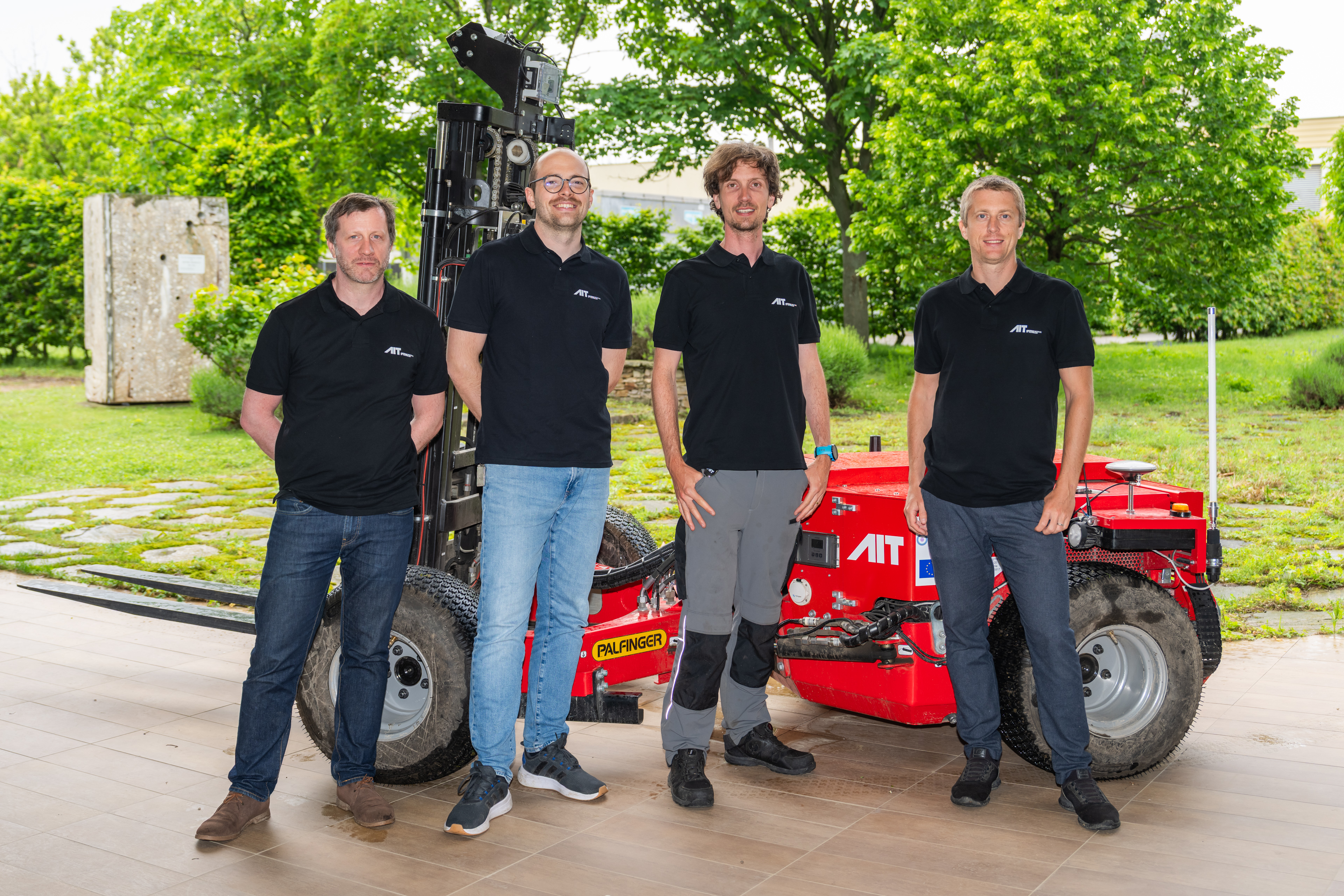
Innovative solutions for construction sites, logistics, forestry, and agriculture: At AIT, key components for the autonomous machines and robots of the future are being developed. Cutting-edge technologies will be showcased on May 30 and 31, 2026, at the “Festival of Robots” on Vienna’s Karlsplatz.
Whether in manufacturing, on construction sites, in forests, or in logistics: robots and autonomous machines will assist us in our work and relieve us of heavy, monotonous, or dangerous tasks. At the same time, they can also meet increased demands for safety, efficiency, and sustainability—and in many sectors, they also help address the growing shortage of skilled workers.
For intelligent machines to accomplish all of this, they require many capabilities that we humans take for granted but that must first be “taught” to technology—from perception using appropriate sensors to motion planning and control, all the way to verifiable decisions. Only when all parts of this chain work together reliably, even under changing environmental conditions, will automation become practical for real-world use. Artificial intelligence methods play a decisive role here—modern robotics essentially brings artificial intelligence to life.
Significant progress has recently been made at the AIT Austrian Institute of Technology—in close cooperation with universities, such as TU Wien and Tufts University, as well as with industrial companies like Palfinger, Bosch, and Künz. Six research results representing key building blocks of autonomous machines will be presented at the world’s leading robotics conference (ICRA) in Vienna from June 1 to 5, 2026.
- Robust 3D Perception of Objects
Under the name PIRATR, researchers at AIT have developed a fully trained AI system for three-dimensional object recognition based on laser scan data. This system goes beyond classic object recognition: In addition to detecting object position and orientation, it enables the description of variable objects, such as the opening angle of a crane grapple. This data is an essential foundation for robust automation of work processes and safe interaction between autonomous machines. - Precise placement of heavy components using a crane
In practice, the precise guidance and placement of loads using cranes is complicated by pendulum-like swinging. An innovative system now enables predictive control based on camera images for position determination. In conjunction with collision-safe motion planning, this allows for the autonomous picking up and precise placement of components, as well as obstacle avoidance with high precision and stable motion execution. This is of central importance, for example, in dynamic, congested construction site environments.
How robotic systems learn flexibly and remain safe Outside of traditional industrial environments, autonomous machines require flexibility and real-time responsiveness. Machines must be able to adapt to changing conditions and disruptions without exceeding safety distances or limits on movement, force, and workspace. Previous learning and optimization methods could not meet these requirements simultaneously. However, a method developed at TU Wien with AIT participation called “SafeFlowMPC” achieves this—and in real time: A learning model provides motion suggestions that are continuously checked by an algorithm and adjusted as needed to ensure safety limits are maintained at all times—even in dynamic situations.- Safety in the field during autonomous timber loading by a crane
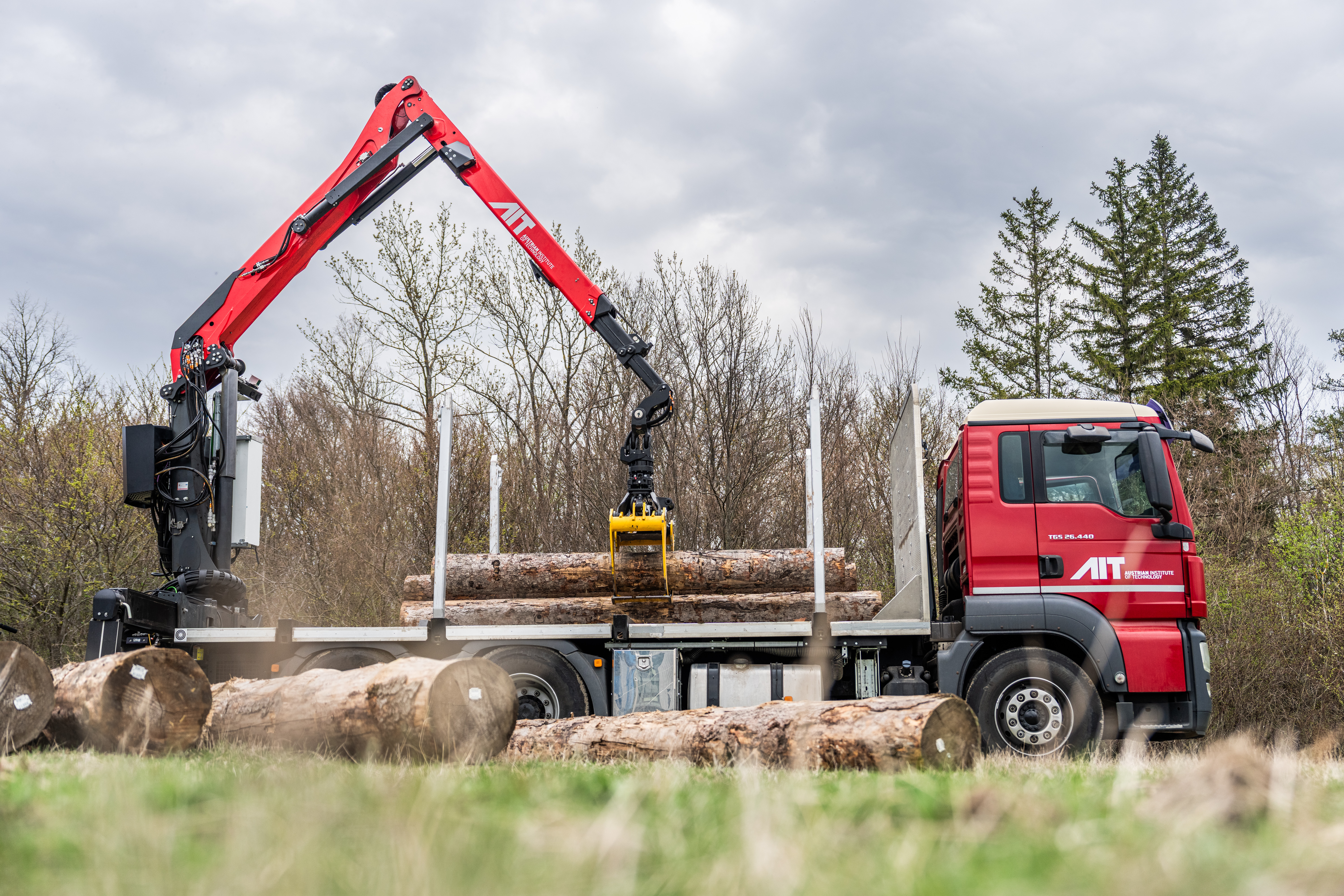
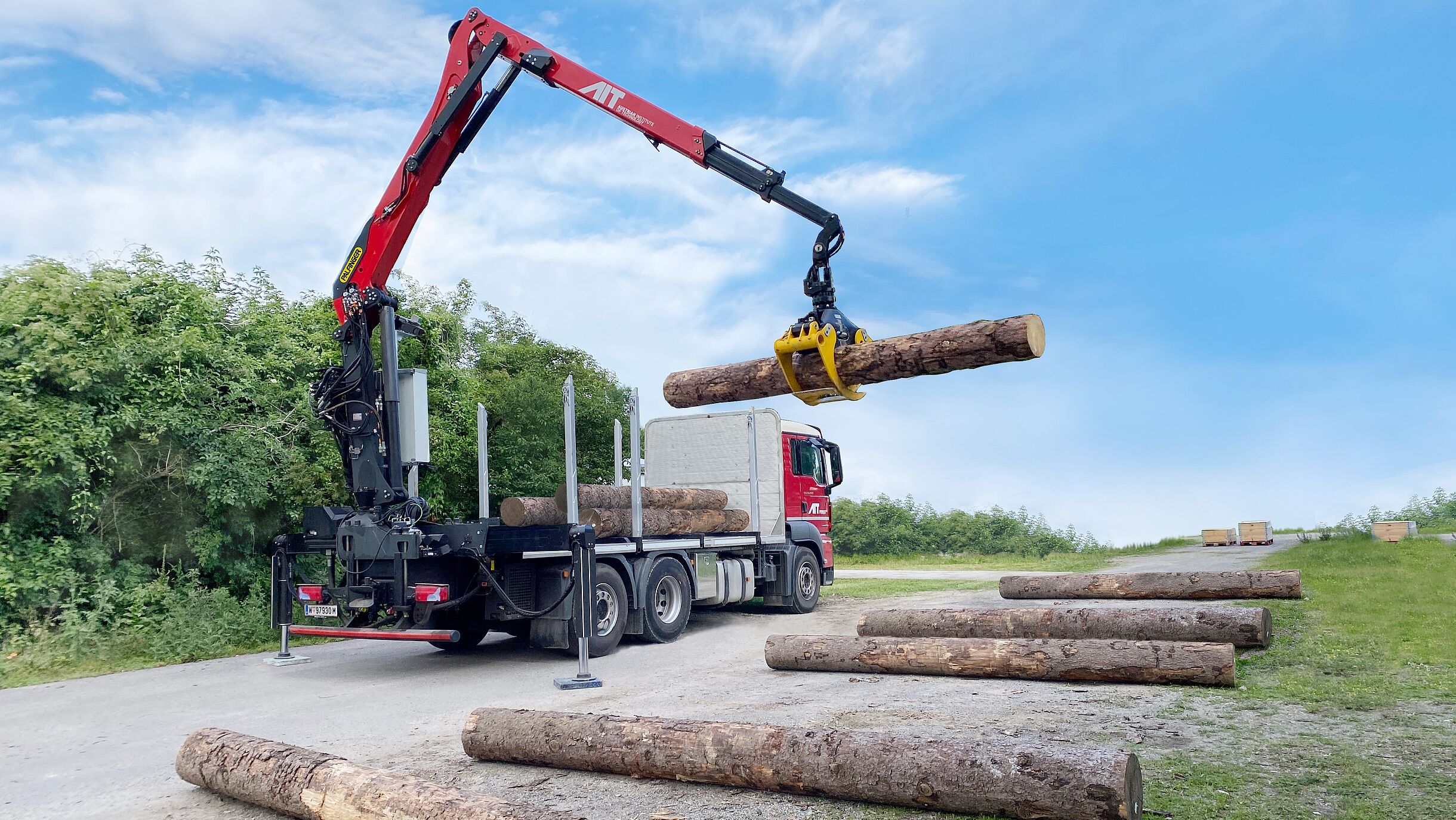
In highly unstructured operating environments, such as forests, timber loading cranes must meet two requirements simultaneously: avoiding collisions and actively damping load oscillations. To this end, the first collision-free, vibration-damping model-predictive controller was developed and installed on a timber loading crane. The system can react to the environment in real time: it can reactively evade obstacles, replan in response to changes, continue working collision-free despite disturbances—and if no evasive maneuver is possible, the machine stops automatically. - How robots learn from repetitive processes and become
more efficient In races with autonomous vehicles, an ideal line is first planned, which is systematically improved lap by lap using feedback from the control system. Deviations during tracking are not viewed as disturbances, but serve as an indication of where the track or vehicle behavior is locally challenging. This creates an adaptive map of permissible accelerations that makes lap times faster step by step. This principle can be applied to autonomous industrial machines with repetitive processes: When a system learns from deviations in execution, movements become more robust and efficient over time, even under changing conditions. - Reliable Autonomy Even for Long Task Chains
Many autonomous systems are already capable of performing individual tasks well. The challenge arises when tasks consist of many consecutive steps (e.g., picking up, transporting, positioning, setting down) and each step must build correctly upon the previous one. In such cases, planning, intermediate steps, and consistency across longer sequences become critical. Among several possible approaches, a so-called “neuro-symbolic architecture” proved to be both more reliable and more energy-efficient. This combines symbolic task planning (sequence of steps, rules, checks) with learned low-level skills that reliably execute the individual movements. With this transparent task logic and robust skills, autonomy can function stably in everyday life.
World premiere for autonomous crane
These research findings are directly incorporated into the further development of autonomous machines at the AIT Large-Scale Robotics Lab—with the goal of continuously making autonomy safer and more capable. The focus is on technologies that prove themselves in real-world environments: robust against disruptions, safe in operation, and efficient in execution.
You can see how this works in practice at the “Festival of Robots” on May 30 and 31, 2026, at Vienna’s Karlsplatz. There, the operation of a fully autonomous robotic crane—developed by AIT in collaboration with TU Wien and Palfinger—will be demonstrated live to the public for the first time. By combining imaging sensors, artificial intelligence, systems theory, and an understanding of the physical domain, this crane can autonomously load and unload logs onto a truck. Such autonomous and assistive systems intelligently support people in complex tasks and increase safety, productivity, and competitiveness.
“Robotics is a key technology for our industrial future and is increasingly finding its way into our everyday lives. At the AIT Austrian Institute of Technology, we are actively shaping this development: from autonomous systems to AI-supported assistive technologies that specifically support people in their work and open up new applications. Our goal is to rapidly translate cutting-edge research into practical applications in collaboration with our partners. This creates solutions that make processes more efficient, enhance safety, and sustainably strengthen the innovative capacity and competitiveness of our industry,” explains Andreas Kugi, Scientific Director of AIT.
Festival of Robots, May 30 and 31, 2026, Karlsplatz, Vienna
AIT at the Robotic Festival: Festival der Roboter - AIT Austrian Institute Of Technology (german only)
ICRA 2026 https://2026.ieee-icra.org/
Large Scale Robotics Lab https://www.ait.ac.at/labs/large-scale-robotics-lab
Photo Gallery