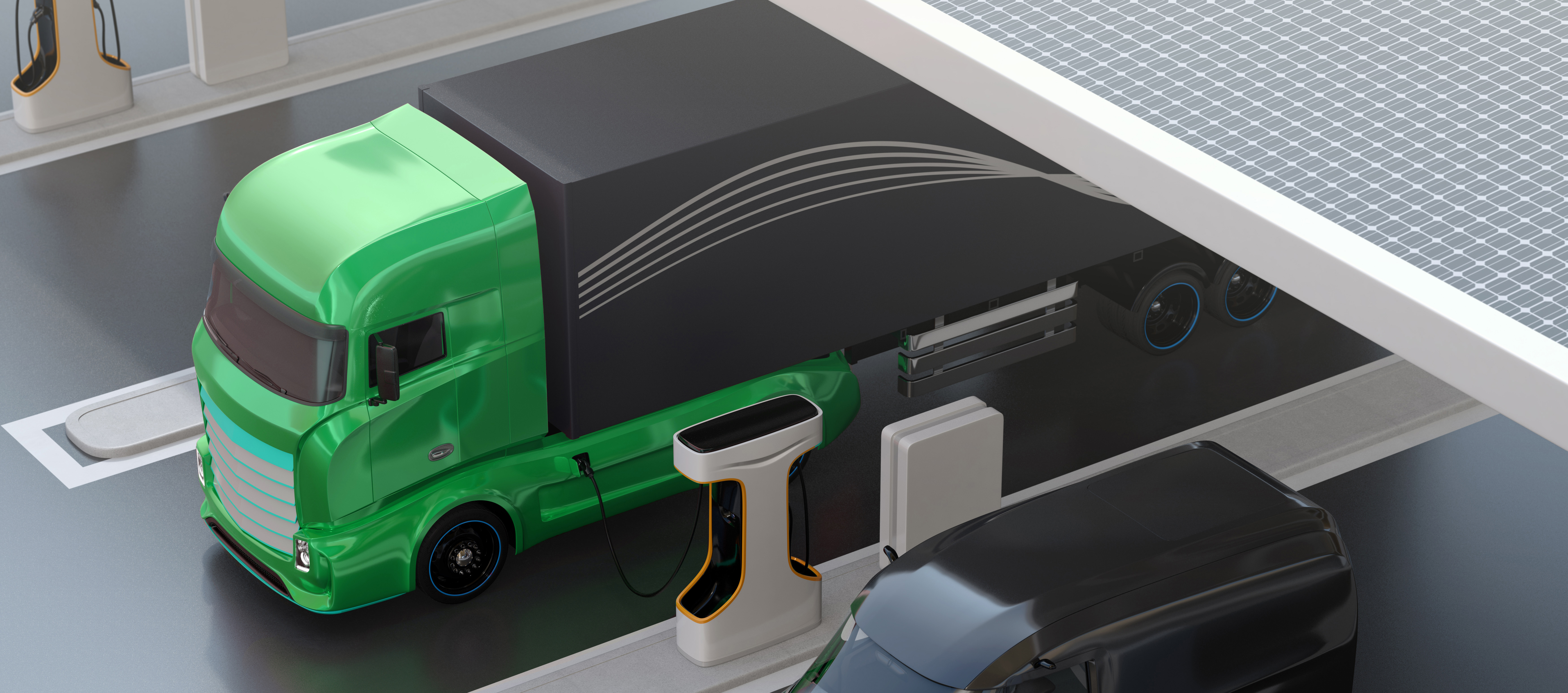
The complete electrification of heavy goods vehicles and buses places high demands on the charging infrastructure. For example, a charging capacity of up to three megawatts is required during a lorry‘s mandatory driver break, which places an enormous load on the electrical distribution grid. In order to meet this challenge, high-performance charging stations must be connected directly to the medium-voltage grid with up to 20 kilovolts, as higher outputs are efficiently available there. Existing systems with conventional 50 hertz transformers are reaching their limits in terms of weight, volume and use of materials. Innovative approaches are therefore required to provide a compact, powerful and grid-stabilising solution.
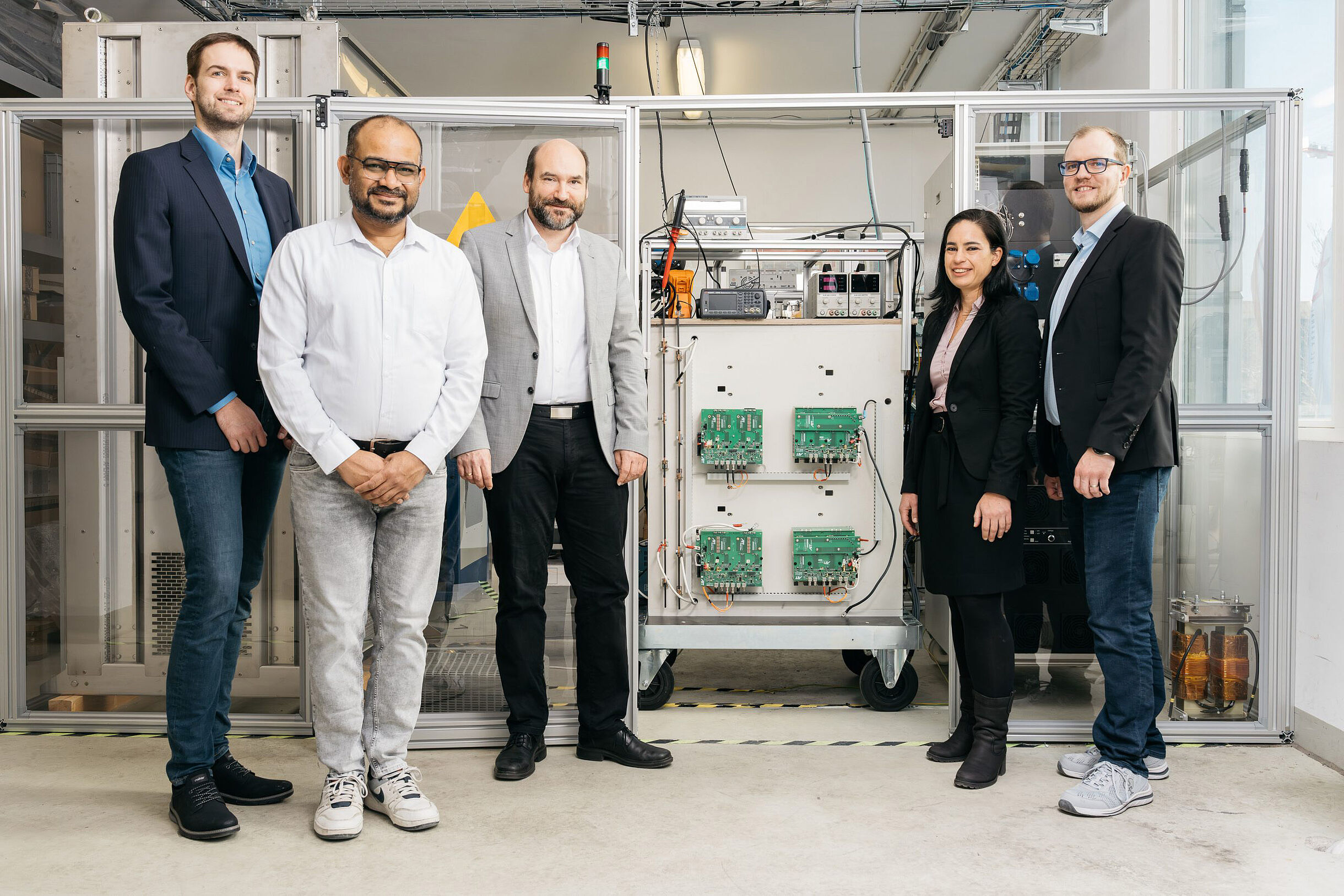
With the development of the MEDUSA multi-megawatt fast-charging station – funded by the Climate and Energy Fund – AIT has created a pioneering technology. In contrast to conventional transformers, the MEDUSA system utilises several high-frequency transformers that are operating at 50 kilohertz, making them much smaller and lighter. This technology is complemented by innovative power electronics based on gallium-nitride semiconductors, which enable high-frequency switching processes and generate direct current at the output of the transformers. In combination, these components form a so-called solid state transformer with significantly increased energy efficiency and power density. With this system, both fast charging of up to three megawatts and several simultaneous charges of 150 kilowatts can be realised, which can cover the charging requirements of around 20 cars.
The higher supply voltage means that the cables and busbars are significantly more compact and lighter, while heavy foundations and conventional 50 Hz transformers are no longer requiered. The integration of battery storage and photovoltaic systems also enables a reduction in CO2 emissions and grid independence in certain scenarios. This makes the technology particularly attractive for regions with a weak grid infrastructure and represents a decisive advantage for the implementation in many countries around the world.
This innovative approach by the AIT has attracted international attention. There are only a handful of institutions in the world that can develop comparable solutions. The combination of expertise in medium-voltage power electronics and specialised research infrastructure for high voltages and power gives the AIT this leading position. The MEDUSA project was also awarded the prestigious Houska Prize 2025 in the category “non-university research”. The introduction of the MEDUSA system has already found its first practical applications, including the construction of production facilities for charging stations in India. In addition, the technology opens up far-reaching potential applications in the aerospace industry, on ships and in public power supplies, where highperformance medium-voltage converters are becoming increasingly important.
In future, the AIT will further intensify its research in the field of high-performance charging technologies and drive forward the development of grid-stabilising and efficient charging infrastructures. By continuously expanding its expertise in medium-voltage power electronics, the AIT will strengthen its technological leadership and establish Austria as a central innovation location for highperformance electrical systems.