Jump to content

DATA BRATA identifies quality issues at an early stage

09.04.2026

A key objective in many industrial processes is to detect quality deviations as early as possible, thereby minimising waste and using resources more efficiently.
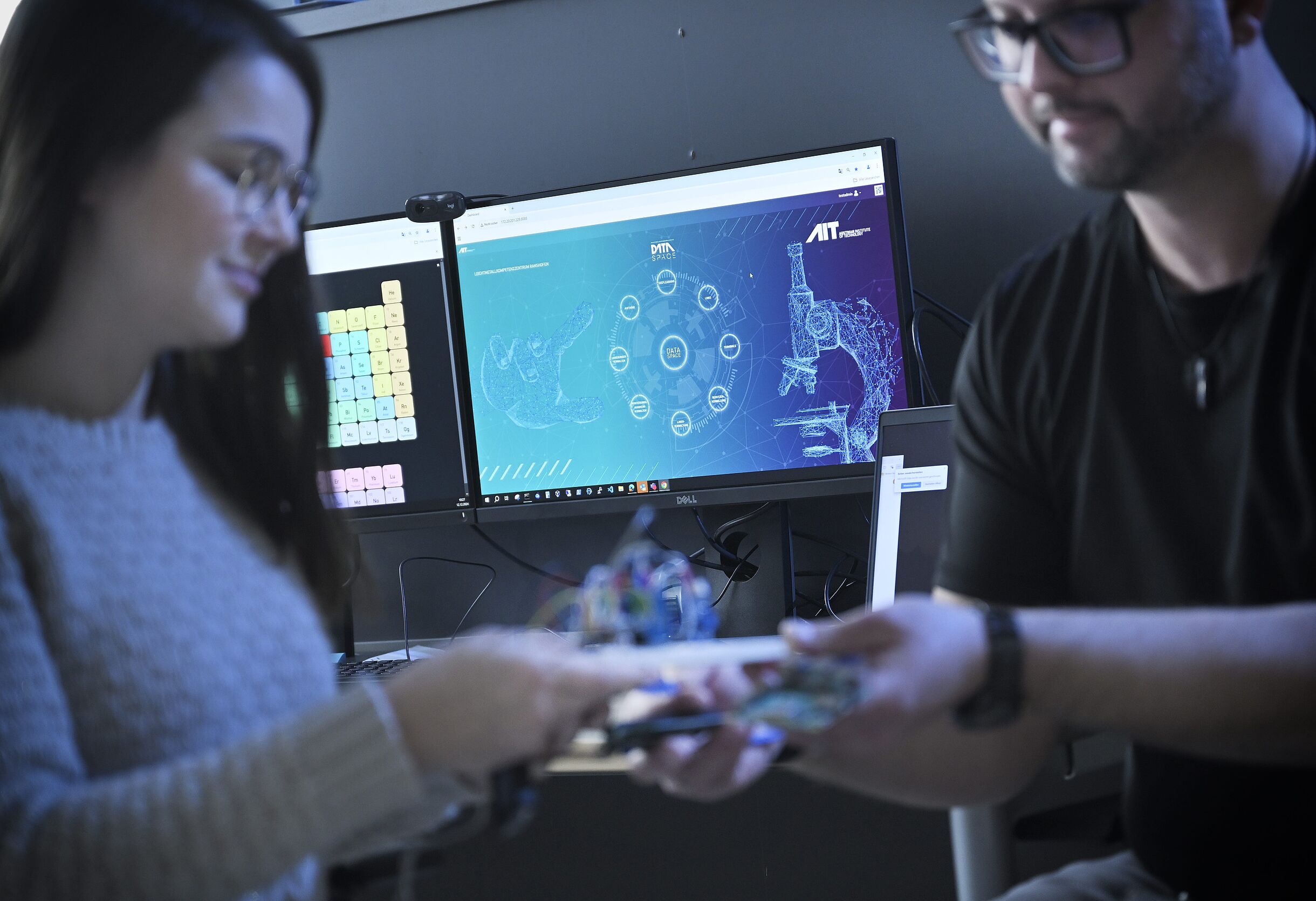

With DATA BRATA, the AIT’s LKR Light Metal Competence Centre in the town of Ranshofen, has developed a modular technology framework that integrates data analysis and machine learning directly into industrial processes. The name follows the clear system principle: Boxed, Reconfigurable, Adaptive, Transportable, Analysis – DATA BRATA is a mobile data and AI platform that connects directly to machines, aggregates signals in real time and derives concrete recommendations for action from them. The aim is to detect process deviations and tool wear at an early stage, before they affect  the quality of the end products.

The system builds on empirical knowledge from production and translates this into digital patterns: sensors record forces, displacements, vibrations, acoustics and temperature. The data is transmitted in real time, and at the Edge, AI aggregates the signals to make decisions. The sequence is crucial: first domain knowledge, then sensor technology and data architecture, and only then AI – to achieve reliable results without excessive overhead.

In a practical test at the Ranshofen site, the system has already been trialled on a 250-tonne hydraulic deep-drawing press. Several thousand components were recorded and analysed in real time; deliberately introduced deviations (such as micro-cracks or differences in the raw material) served as a training basis for time-series analyses and machine learning models. Following successful trials and an industrial deployment that has already been implemented – including at MARK Metallwarenfabrik – DATA BRATA is being gradually further developed and applied to additional use cases. Sectors such as metalworking, the automotive industry and aerospace technology are being targeted.

The system is currently in pilot operation and is intended as a Function-as-a-Service (FaaS) and Research-as-a-Service (RaaS) – with the aim of enabling companies to achieve data-driven improvements in quality and efficiency in real time without significant implementation effort. This is of particular interest to Austrian companies in these sectors, which are typically highly specialised SMEs, and can provide them with a significant competitive advantage.