

Bioinspired Electrodes for Efficient and Scalable electrocatalytic CO2 reduction to high added-value products
The electrocatalytic CO2 reduction reaction (CO2RR) is the most promising route for CO2 utilization, due to its efficiency, versatility, scalability and compatibility with renewable energies. BEES-4-CO2RR develops efficient, sustainable and up-scalable catalytic electrodes, inspired from nature and integrated in a scalable flow reactor, for the efficient CO2RR to CH4 and other hydrocarbons. The technical innovations proposed in the project will have a broad impact for the energy and chemical industries.
At the center of the proposed concept is the development of novel, porous, catalytic materials on gas diffusion electrodes (GDEs), combining sputtered Cu and Cu-Zn-alloy catalysts with multifunctional, bio-inspired poly-ionic liquid structures, specially engineered and produced using nano imprint lithography (NIL). These innovative electrodes pack numerous critical functionalities to boost CO2RR performance. These are:
(i) (Super)hydrophilicity combined with (super)aerophobicity of the novel active material surface, through the bio-inspired structuration. This guarantees optimal wetting of the catalyst with the electrolyte and fast release of the formed gaseous products, to free the catalytic sites for further reactions, boosting activity and current stability.
(ii) Enhanced catalytic properties, through the implementation of selective Cu-Zn-alloy metal catalysts, combined with imidazolium functionalization of the polymer, which activates the solubilized CO2, thus improving the process at the triple-phase boundary and increasing the amount of CO2 interacting with the catalyst.
(iii) Hydrophobicity of the supporting porous substrate thus avoiding the so-called "flooding" of the electrode with the electrolyte. The use of porous, non-fluorinated polymer foils as a substrate, instead of the more common carbonaceous GDE, is anticipated to have such a beneficial effect, leading to long-term stability.
(iv) Enhanced electrical conductivity of the electrode. Apart from using highly conducting metal catalysts, the NIL polymer's conductivity will be boosted with embedded Cu active species and/or Cu islands deposited on the polymer surface, having a net positive impact on the current density and selectivity.
Project goals
The developed multifunctional electrode: (i) is processed using up-scalable methods of sputtering and NIL, (ii) uses non-CRMs (critical raw materials), without compromising performance, (iii) explores alternatives to fluorinated-polymer porous substrates, (iv) implements an easily up-scalable flow-reactor design where CO2 is provided to the active catalytic sites via a GDE to avoid the mass transport limitations.
When implemented in the final system, the proposed concept aims to achieve a CO2-to-CH4 faradaic efficiency close to 85% with a stability of more than 100 h, while maintaining a current density of more than 100 mA/cm2.
Project results
AIT successfully deposited Cu-Zn alloys onto a polyethylene (PE) substrate (a porous, non-fluorinated polymer) with composition gradients of Zn varying between ~37 and 77 at. % using sputter deposition. (Figure 1).
Cu and Cu-Zn deposited onto PE were tested for the CO2RR utilizing a flow cell reactor with CO2 directly introduced to the backside of the gas diffusion electrode. Faradaic efficiencies towards CH4 of 20 to 35 % were achieved in 0.5M NaHCO3 and 0.5M KHCO3 at different potentials as demonstrated in Figure 2.
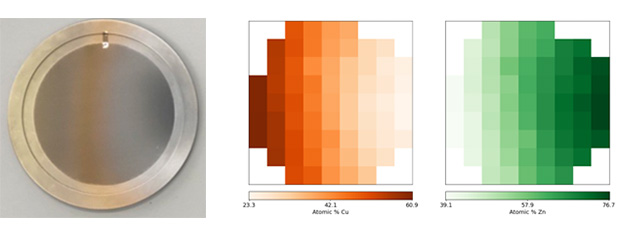
Figure 1: Cu-Zn alloy sputtered onto a polyethylene substrate
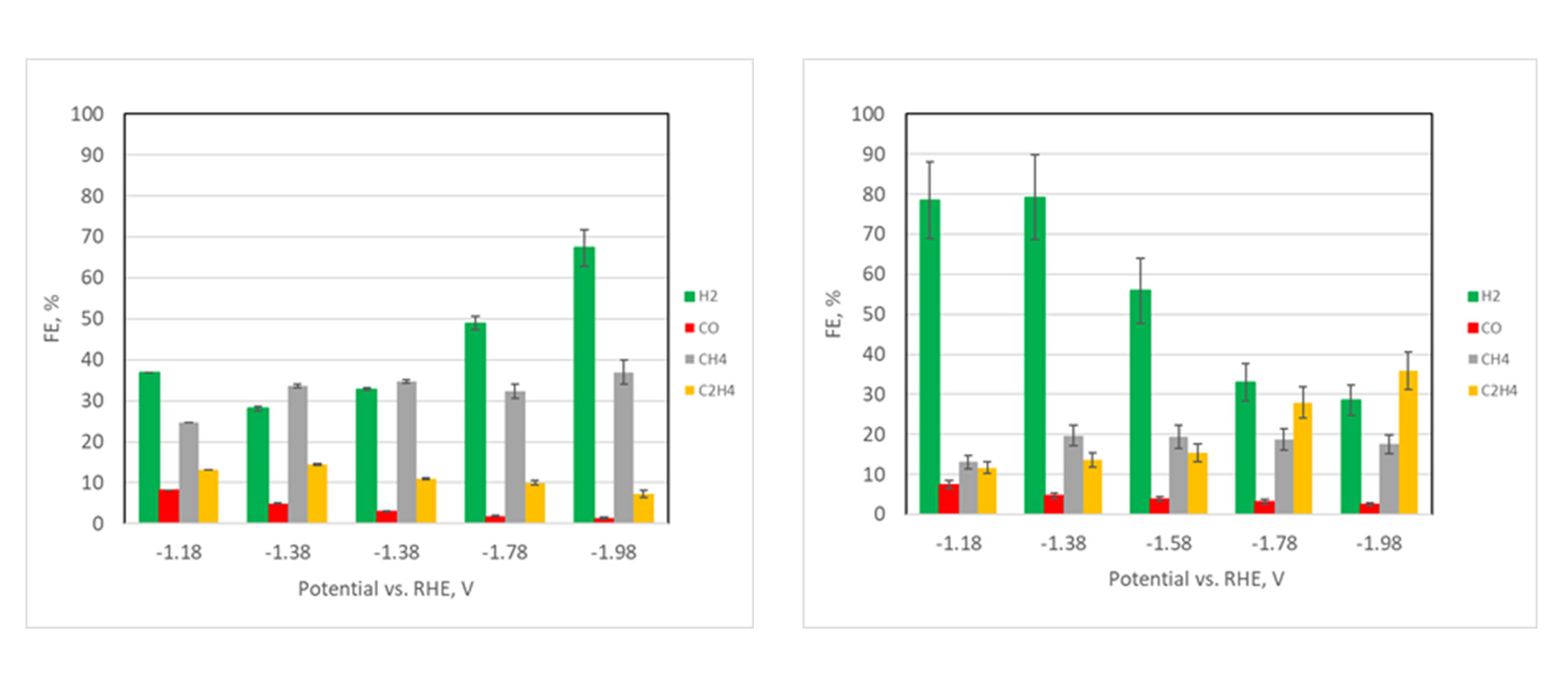
Figure 2: Faradaic efficiencies vs Potential for the CO2RR in 0.5M NaHCO3 (left) and 0.5M KHCO3 (right)

This project is funded by the Federal Ministry for Innovation, Mobility and Infrastructure as part of the call for proposals ‘Key Technologies in Production-Related Environments, 2024’.